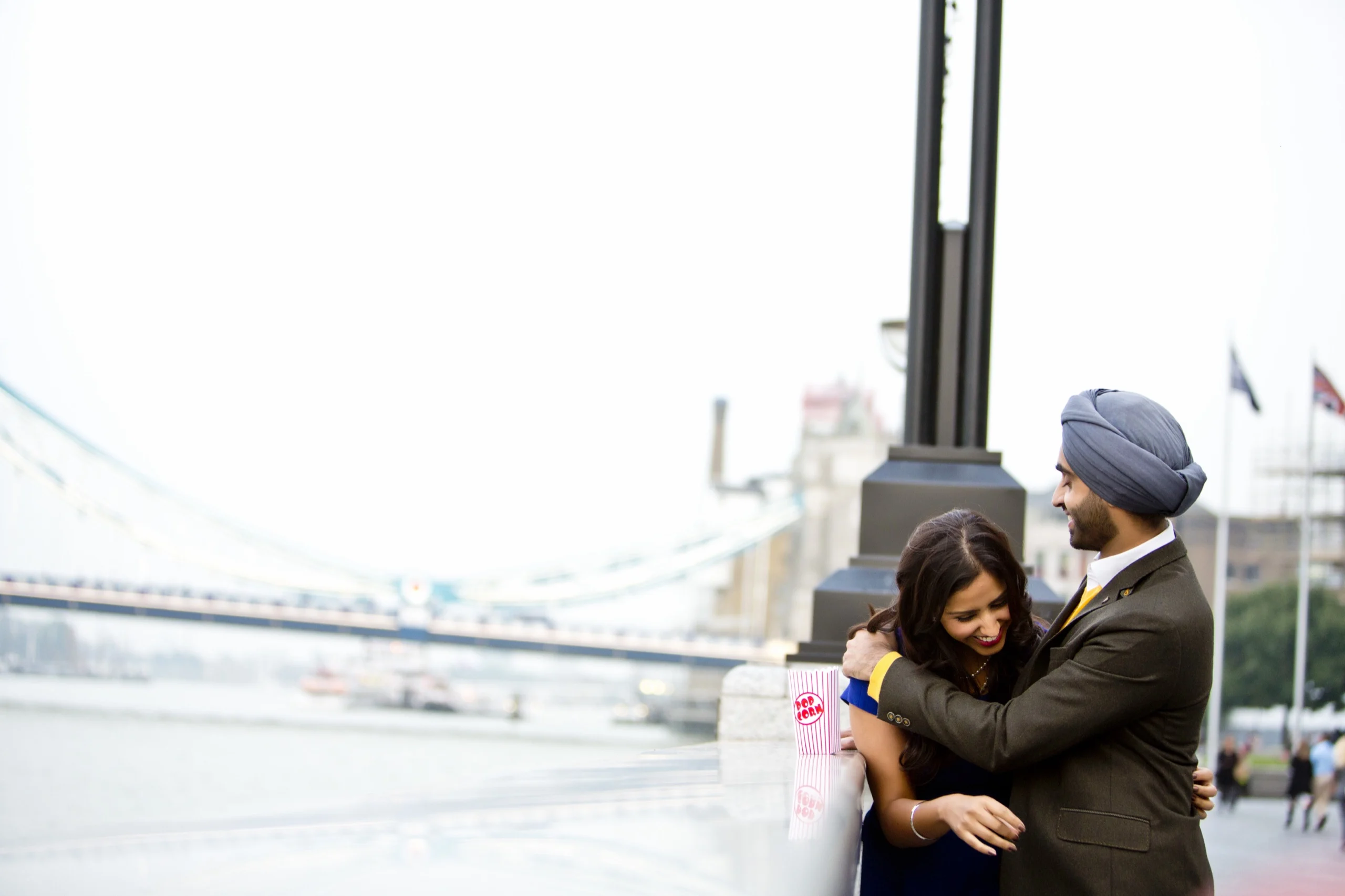
A UK wedding day usually runs 13 to 16 hours from the first hair appointment to the last song, and almost every timing in it is set by two things: your ceremony time and your sunset. Below are three full sample timelines for 11am, 1pm and 3pm ceremonies, with clock times for every part of the day, followed by how to adjust them for summer and winter light and where your photographer and filmmaker need time.
The short answer: For a 1pm ceremony, start hair and make-up around 9am, walk out married at about 1.30pm, enjoy a 90-minute drinks reception with family photos and portraits, sit down around 3.15pm, and plan your first dance for about 8pm. Move portraits to match your sunset.
These are the timings we see work at the weddings we photograph and film across London, Kent and the South East. Treat them as a starting point, not a rulebook: your venue, your officiant and your family will shape the final version.
How do you plan a wedding day timeline?
Start with the fixed points, then fill in around them. There are usually four:
- Your ceremony time. Set by your registrar, vicar, celebrant or place of worship, and rarely movable on the day.
- Your meal time. Your caterer or venue will have a preferred window for serving the wedding breakfast.
- Your sunset. It decides when your couple portraits can happen in natural light, and it moves by more than five hours between June and December in London.
- Your evening guests’ arrival. Usually printed on the invitation, so it can’t slip. It is also a good moment to open a guest portrait studio instead of a photo booth, so new arrivals have something to do.
Work backwards from the ceremony for the morning and forwards for the rest of the day. Then add the buffers (more on those below) and share one version with everyone: venue coordinator, caterer, photographer, filmmaker, band or DJ, and the family member who will gather people for photos.
Guest numbers matter too. The average UK wedding has 74 guests at the ceremony and about 21 extra in the evening, according to the Bridebook UK Wedding Report 2026. With a much bigger guest list, confetti, receiving lines and group photos all take longer, so give them more room.
Sample timeline: an 11am ceremony
An 11am start suits church weddings, which often run 45 minutes to an hour, winter weddings when daylight is short, and couples who want a long, unhurried afternoon. The trade-off is an early morning and a longer gap to fill before the evening.
| Time | What happens | Photo and film notes |
|---|---|---|
| 7.00am | Hair and make-up begins | Allow extra time if several people are being styled |
| 8.30am | Photographer and filmmaker arrive | Details first: dress, rings, shoes, invitation, perfume, letters |
| 9.00am | Partner’s preparations (if nearby) | One of the team moves between the two rooms |
| 9.45am | Getting dressed, final touches | Window light; parents or close friends helping |
| 10.15am | Leave for the ceremony | Short portraits by the car or front door |
| 10.30am | Guests arrive, ushers seat them | Filmmaker fits small microphones on whoever is officiating, where allowed |
| 11.00am | Ceremony (about 30 to 60 minutes) | Agreed positions; no flash during the service |
| 11.50am | Confetti and congratulations | Ask guests to line the path; it takes two minutes to set up |
| 12.00pm | Drinks reception begins | Candid photos of guests and children |
| 12.10pm | Family photographs (8 to 10 groups) | About 20 to 30 minutes |
| 12.45pm | Couple portraits | About 20 minutes, close to the drinks |
| 1.30pm | Room photos before guests enter | 10 minutes with the room untouched |
| 1.45pm | Guests called to the wedding breakfast | Entrance as a couple |
| 2.00pm | Wedding breakfast | Team takes its meal break |
| 3.45pm | Speeches | Microphone for every speaker; filmmaker records each one in full |
| 4.30pm | Cake cutting | Before the light outside goes in winter |
| 4.45pm | Golden hour portraits (spring and autumn) | 10 to 15 minutes; in summer, move to the evening |
| 5.00pm | Quiet time: lawn games, rest, room turnaround | A good point for a short break |
| 7.00pm | Evening guests arrive | |
| 7.30pm | First dance | Usually the last big moment for photo and film |
| 8.00pm | Dance floor; evening food at 9pm | Coverage often ends 30 minutes after the first dance |
| 11.30pm | Last song and carriages |
This day uses about 11 and a half hours of coverage if you want everything from details to dancing. To bring it down, start later in the morning or finish after the cake. In December, the 4.45pm portrait slot is too late: sunset in London is around 3.50pm, so do your portraits straight after the family photos instead.
Sample timeline: a 1pm ceremony
This is the most common shape for a civil or venue wedding in the UK, and it works in every month except the darkest weeks of winter. The ceremony time gives a calm morning and a meal in the mid-afternoon.
| Time | What happens | Photo and film notes |
|---|---|---|
| 9.00am | Hair and make-up begins | |
| 10.45am | Photographer and filmmaker arrive | Details, room, people getting ready |
| 11.30am | Partner’s preparations | Buttonholes, cufflinks, a note or gift exchanged |
| 12.15pm | Getting dressed | |
| 12.30pm | Guests arrive | Filmmaker sets up and fits microphones |
| 12.45pm | Partner waits at the front; ushers seat the last guests | A few photos of the partner waiting |
| 1.00pm | Ceremony (civil ceremonies often 20 to 30 minutes) | Entrance, vows, rings, signing, first kiss |
| 1.30pm | Recessional and confetti | |
| 1.45pm | Drinks reception and canapés | Candids and guests |
| 2.00pm | Family photographs | 20 to 30 minutes from a written list |
| 2.30pm | Couple portraits | About 20 minutes |
| 3.00pm | Room and detail photos | Before guests enter |
| 3.15pm | Guests called to sit down | |
| 3.30pm | Couple’s entrance and speeches before the meal | About 30 to 45 minutes in total |
| 4.15pm | Wedding breakfast | Team’s meal break |
| 6.00pm | Cake cutting | |
| 6.15pm | Golden hour portraits in spring and autumn | 10 to 15 minutes |
| 7.30pm | Evening guests arrive | |
| 7.45pm | Golden hour portraits in May and August | Slip out for 10 minutes; in June and July, go after the first dance, around 8.30pm |
| 8.00pm | First dance | |
| 8.30pm | Dance floor | Coverage often ends around here |
| 9.00pm | Evening food | |
| 11.30pm | Carriages |
A 1pm ceremony needs roughly ten hours of coverage from preparations to the first dance. If your budget allows eight, start the coverage at about 12.15pm, as you get dressed.
Sample timeline: a 3pm ceremony
A later ceremony gives you a slow morning and a shorter, livelier day, and it lines the evening up with the best summer light. It is a good fit from late April to early September. In winter it leaves no daylight after the ceremony at all.
| Time | What happens | Photo and film notes |
|---|---|---|
| 11.00am | Hair and make-up begins | |
| 12.45pm | Photographer and filmmaker arrive | Details and preparations |
| 1.30pm | Partner’s preparations | |
| 2.15pm | Getting dressed | |
| 2.30pm | Guests arrive | Microphones fitted |
| 3.00pm | Ceremony | |
| 3.30pm | Confetti | |
| 3.45pm | Drinks reception | |
| 3.55pm | Family photographs | 20 to 30 minutes |
| 4.30pm | Short couple portraits | 15 minutes; the longer session comes later |
| 5.15pm | Guests called to sit down | Room photos just before |
| 5.30pm | Speeches before the meal | |
| 6.15pm | Wedding breakfast | |
| 8.00pm | Evening guests arrive | |
| 8.15pm | Golden hour portraits | In June and July golden light starts around 8.20pm |
| 8.45pm | Cake cutting and first dance | |
| 9.15pm | Dance floor, evening food | Coverage often ends here |
| 12.00am | Carriages |
A 3pm ceremony packs the day into about eight and a half hours of coverage, which can save you money. Keep the drinks reception tight, because the evening arrives quickly.
Should speeches be before or after the meal?
There is no wrong answer, and we see both at the weddings we cover.
- Before the meal. Speakers stop worrying and enjoy their food, the kitchen isn’t held up, and the room is at its most attentive. It suits most of the days above.
- After the meal. The traditional order. It suits an 11am ceremony with a long afternoon to fill, and toasts flow naturally with dessert and coffee.
- Between courses. Spreads the speeches out, but ask your caterer first: some kitchens find it hard to time.
For film, the order matters less than the sound. Every speaker should use the microphone, and your filmmaker needs to know who is speaking and when. Our guide to getting your wedding speeches filmed and heard properly covers the audio side in detail.
How long is the gap between the ceremony and the wedding breakfast?
Plan for about two hours from the end of the ceremony to guests sitting down, and never less than 90 minutes. Here is where that time goes:
| Part of the gap | Time it needs |
|---|---|
| Recessional, confetti, hugs and congratulations | 15 minutes |
| Family photographs (8 to 10 groups) | 20 to 30 minutes |
| Couple portraits | 20 minutes |
| Room photos, and the venue calling guests through | 15 minutes |
| Your own time with guests, a drink and a canapé | 30 minutes or more |
If your family list is long, start with our step-by-step guide to planning a family photo list, including what changes when you have 200 or 300 guests.
How to adjust your timeline for summer and winter sunsets
This is the part most sample timelines leave out, and it is the one that changes your photographs the most. In London the sun sets around 9.20pm in late June and around 3.50pm in mid-December. The table shows mid-month times for London, rounded to the nearest five minutes. Beckenham and north-west Kent are within about a minute of these.
| Month (15th) | Sunset around | Golden light starts around | What it means for a 1pm ceremony |
|---|---|---|---|
| January | 4.20pm | 3.25pm | Portraits straight after family photos |
| February | 5.15pm | 4.25pm | Portraits after family photos; golden light comes during the speeches |
| March | 6.05pm | 5.20pm | Golden hour falls during the meal |
| April | 7.55pm | 7.10pm | Golden hour just before the evening guests arrive |
| May | 8.45pm | 7.55pm | Golden hour around the first dance |
| June | 9.20pm | 8.25pm | Golden hour after the first dance |
| July | 9.10pm | 8.20pm | Golden hour after the first dance |
| August | 8.25pm | 7.35pm | Golden hour around the evening guests’ arrival |
| September | 7.15pm | 6.30pm | Golden hour after the meal |
| October | 6.10pm | 5.20pm | Golden hour during or just after the meal |
| November | 4.10pm | 3.20pm | Portraits straight after family photos |
| December | 3.50pm | 2.50pm | Portraits straight after the ceremony; consider 11am or noon |
Times are calculated for London with the NOAA solar position method and agree with sunrise-sunset.org to within a couple of minutes. Golden light here means the sun is less than six degrees above the horizon.
Watch the clocks, too. In 2027 the clocks go forward on 28 March and back on 31 October, according to GOV.UK. Overnight, sunset moves by an hour, so a wedding on the last Saturday in October and one on the first Saturday in November have very different evenings. Our month-by-month guide to golden hour wedding photos in the UK has the full table, including blue hour, and our guide to winter wedding photography shows how to plan a December day around a 3.50pm sunset.
Two rules of thumb we use when we look at a couple’s plan:
- Winter (November to January): finish the ceremony by about 2pm to 2.30pm, and do family photos and portraits straight away.
- Summer (May to August): keep a short portrait session after the ceremony, then slip out for ten minutes of golden light in the evening. It is usually the softest light of the day.
Rain is a planning question in every month. Even in summer, about one day in four has at least 1mm of rain at Heathrow, according to Met Office 1991 to 2020 averages. Agree an indoor spot for family photos with your venue in advance, and read our wet-weather photo and film plan before the day.
Where do photo and film need time on the day?
A photographer and a filmmaker can work almost invisibly for most of the day. These are the moments where a few protected minutes make a real difference.
| Moment | What we need | Why it matters |
|---|---|---|
| Final 30 minutes of getting ready | Dressing near a window, a tidy corner of the room | The calmest, most personal pictures of the day |
| 15 minutes before the ceremony | The officiant agreeing positions; microphones fitted | Clean audio of the vows and a clear view of the aisle |
| The ceremony | Guests’ phones down, if you are happy to ask | Nobody leaning into the aisle at the moment you see each other |
| Confetti | Two minutes to line guests up | One take, so it is worth organising |
| Family photos | A written list and a family member who knows everyone | The difference between 20 minutes and an hour |
| Couple portraits | 20 minutes, plus 10 minutes at golden hour | Relaxed rather than rushed |
| The room before guests enter | 10 minutes | Your styling, before it is moved |
| Speeches and first dance | Order, names and the music in advance | Nobody is changing a lens at the wrong moment |
A few of these have their own guides. What to do (and not do) for your getting-ready photos covers the morning. How to ask guests for an unplugged ceremony helps with the aisle. If the portraits are the part you are dreading, read how to relax in front of a photographer and filmmaker first. And if you are wondering whether to see each other before the ceremony, especially in winter, our guide to whether a first look is right for you weighs it up.
Where do wedding days run late, and how much buffer do you need?
Every wedding day runs a little late. The question is where you absorb it. These are the places we see time slip most often, with the buffer we suggest:
- Hair and make-up: add 30 minutes to whatever your stylist quotes for the whole party.
- Leaving for the ceremony: 15 minutes. Cars, dresses and last-minute photos all take longer than planned.
- Travel between ceremony and reception venues: add 50% to the journey time, especially in London traffic or on Saturday afternoons.
- Ceremony start: in our experience, most ceremonies start five to ten minutes late. Registrars have other weddings that day, so don’t plan on more.
- Drinks reception: the most flexible part of the day. If you are running late, shorten the drinks, not the portraits or the meal.
- Speeches: ask speakers to aim for five to ten minutes each. Three speeches can easily take 45 minutes.
Build these into the plan you give your suppliers, and nominate one person (a coordinator, an usher or a calm friend) to keep an eye on the clock so you don’t have to.
What about multi-day, Sikh, Hindu, Muslim, Jewish and African weddings?
The three timelines above are written for a single-day church, civil or venue wedding. Many of the weddings we photograph and film don’t follow that shape, and that is a good thing.
- Multi-day Asian weddings spread the celebrations across mehndi, sangeet, haldi or maiyan, the ceremony and the reception. Our day-by-day Asian wedding timeline plans photo and film coverage event by event.
- Sikh weddings usually begin in the morning with the milni, followed by the Anand Karaj in the gurdwara and the laavan. See our Sikh wedding day timeline, from milni to reception.
- Muslim weddings may hold the nikah and walima on the same day or on separate days. Our realistic same-day nikah and walima timeline shows how.
- Jewish weddings follow their own order, from tisch and bedeken to chuppah and yichud, and can’t take place on Shabbat. That means Saturday-night weddings in summer start late. Read our Jewish wedding timeline for UK couples.
- African weddings often hold a traditional engagement and a white wedding on separate days, each with an MC-led programme. Our guide to African weddings in the UK includes a two-day schedule.
- Two ceremonies in one day, such as a Hindu ceremony followed by a civil or church wedding, need outfit changes and two sets of family photos. See how fusion couples plan two ceremonies in one day.
Ceremony rules also shape the timeline. In a Church of England church the vicar has the final say on photography and filming, according to the Church of England. Our guides to church wedding photography and filming rules and register office weddings in 30 minutes explain what to ask.
From behind the camera
After more than a decade of weddings, the timelines that work best are rarely the most packed. They are the ones with a little air in them.
I always ask couples for two things before the day: their family photo list and their speech order. Those two pieces of paper save more time than anything else. With a list, a family helper and a spot agreed in advance, ten groups take 20 to 30 minutes. Without them, the same groups can take an hour, and that hour comes out of your drinks reception.
On the film side, the moments that get squeezed are the ones that need sound. A filmmaker needs a couple of quiet minutes before the ceremony to fit small microphones and check levels, and needs to know when the speeches start, so we are not caught at the far end of the garden. If your timeline gives the photographer and filmmaker ten minutes of warning before each big moment, nothing important is missed.
The other thing we see: couples who plan their portraits around the sunset are rarely disappointed. In summer that means ten minutes away from your guests at about eight o’clock. In winter it means walking straight out of the ceremony into the last of the light. Neither costs you anything but a line in the timeline.
When we photograph and film a wedding together, we share one plan between the photographer and filmmaker, so the two of us are never asking you for the same five minutes twice. You can see how we cover the day on our wedding photography and wedding films pages.
FAQs
What is the best time for a wedding ceremony? For most UK weddings, 1pm to 2pm works best. It gives you a relaxed morning, daylight for family photos and portraits in every month except December and January, and a sit-down meal around 3pm to 4pm. Choose 11am or noon for a winter wedding or a long church service, and 3pm or later only in late spring and summer.
Ceremony at 1pm: what time should food be? With a 1pm ceremony, guests usually sit down for the wedding breakfast between 3pm and 3.30pm. That allows about 30 minutes for the ceremony, 15 minutes for confetti and congratulations, and around 90 minutes of drinks while you do family photos and portraits. Check your caterer’s preferred serving time before you print anything.
How long is the gap between the ceremony and the wedding breakfast? Plan for about two hours from the end of the ceremony to guests sitting down, or 90 minutes at the very least. That covers confetti, the drinks reception, eight to ten family groups and 20 minutes of couple portraits. Much longer than two and a half hours and guests get hungry; much shorter and the photos feel rushed.
How long do weddings last in the UK? Most UK wedding days run 13 to 16 hours from the start of hair and make-up to carriages, and guests are with you for about 9 to 13 of them, depending on your ceremony time. The ceremony itself lasts 20 to 60 minutes. Photo and film coverage of six to ten hours usually runs from the last part of getting ready to just after the first dance.
Should speeches be before or after the meal? Both work. Speeches before the meal let nervous speakers relax and enjoy their food, and keep the kitchen on time. Speeches after the meal are traditional and suit a long, relaxed afternoon. Whichever you choose, tell your caterer, photographer and filmmaker so everyone is in place with microphones ready.
Keep reading
- How to plan your family photo list (even for 300 guests): the part of the timeline that most often runs over, and how to keep it to 30 minutes.
- Golden hour wedding photos in the UK, month by month: the full sunset and golden hour table for London and Kent.
- Winter wedding photography in the UK: how to plan a day when the light goes before 4pm.
Send us your date and ceremony time and we will suggest timings that suit your venue and your light. Book a call and we will talk it through.