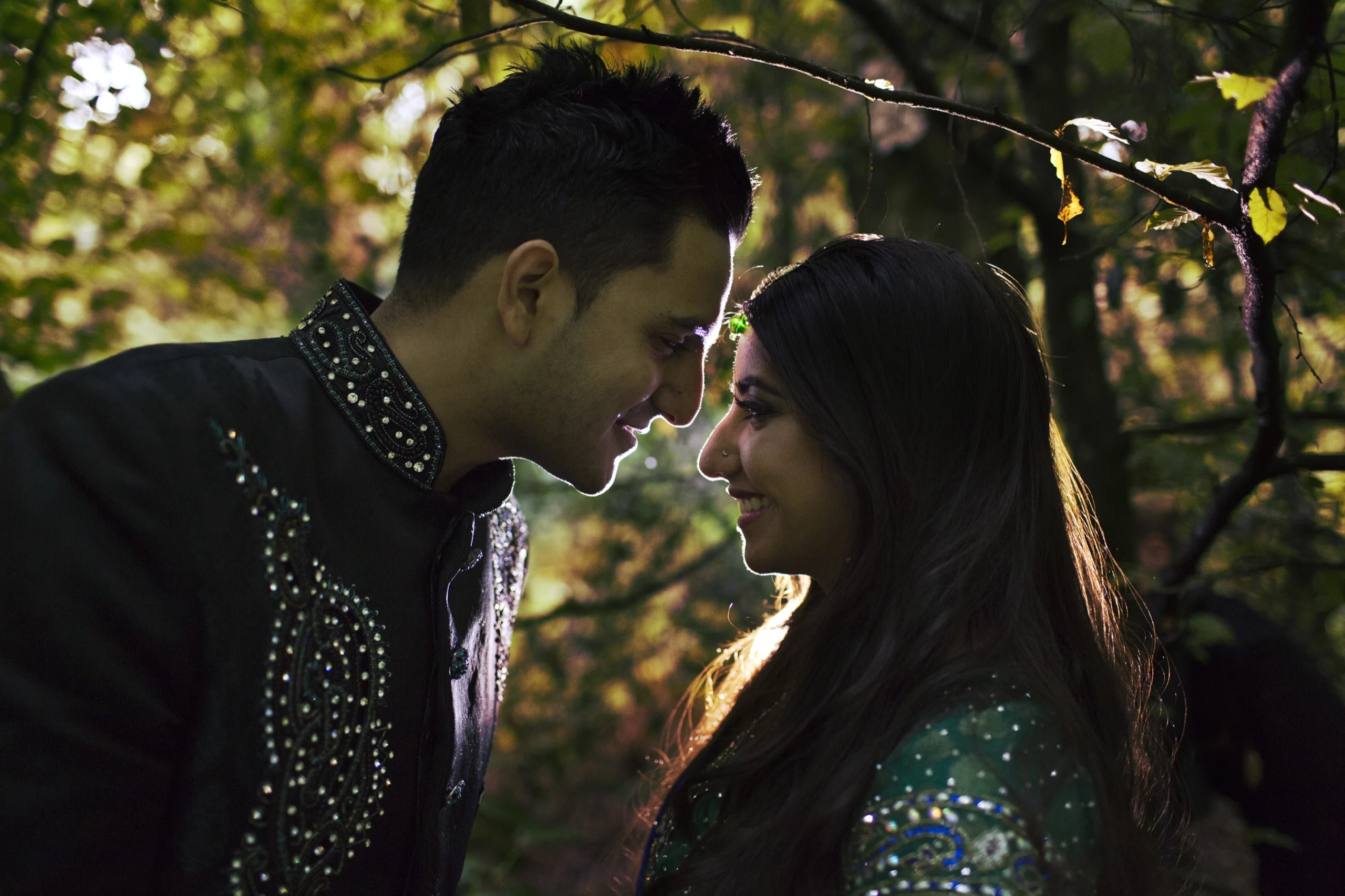
Golden hour is roughly the last hour before sunset, when the sun is low and the light turns soft and warm. In London it starts around 8.25pm in late June and around 2.50pm in mid-December, a difference of more than five hours. Below is a month-by-month table of golden hour and sunset times for London and Kent, what the clocks changing does to your evening, and how to slip away for ten minutes without missing your own wedding.
The short answer: In summer, golden hour falls between about 7.30pm and 9.20pm, so plan ten minutes away from your guests after the meal or around the first dance. In winter it falls between about 2.50pm and 4.20pm, so do your portraits straight after the ceremony.
The light is one of the few things on your wedding day you can’t change, but you can plan around it. Your sunset time shapes the whole wedding day timeline, from when you choose to have your ceremony to when you leave the dinner table.
When is golden hour for wedding photos in the UK?
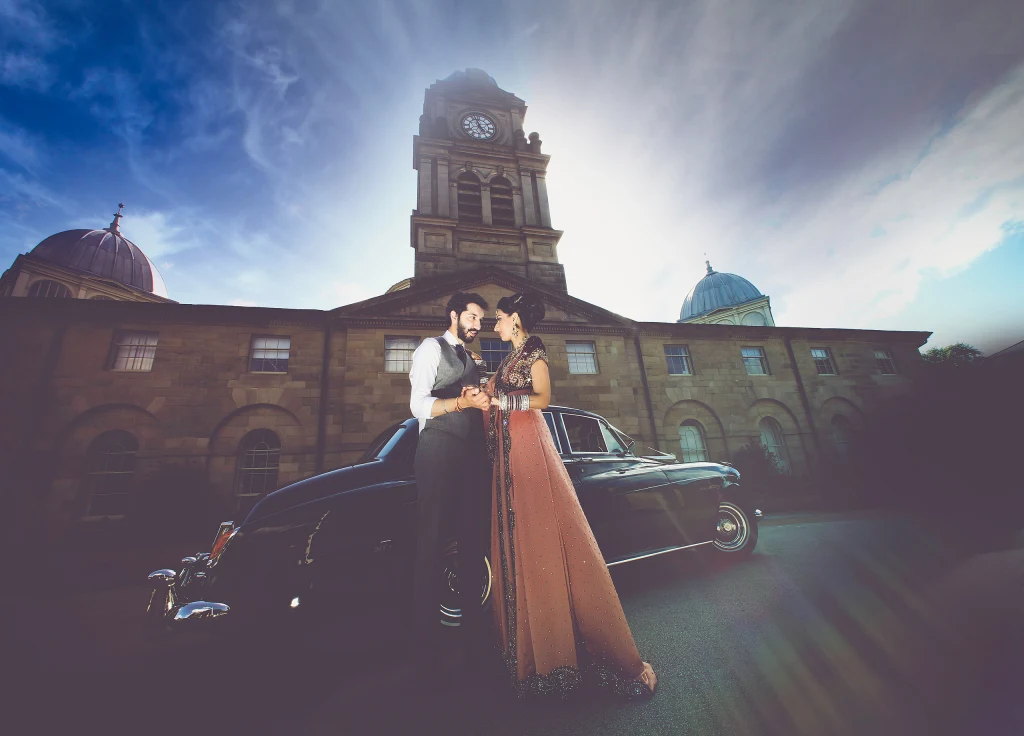
Photographers usually define golden hour as the time from when the sun is six degrees above the horizon until sunset. The sun is low enough to light you from the side or from behind, so the light is warm, soft and directional, and nobody has to squint.
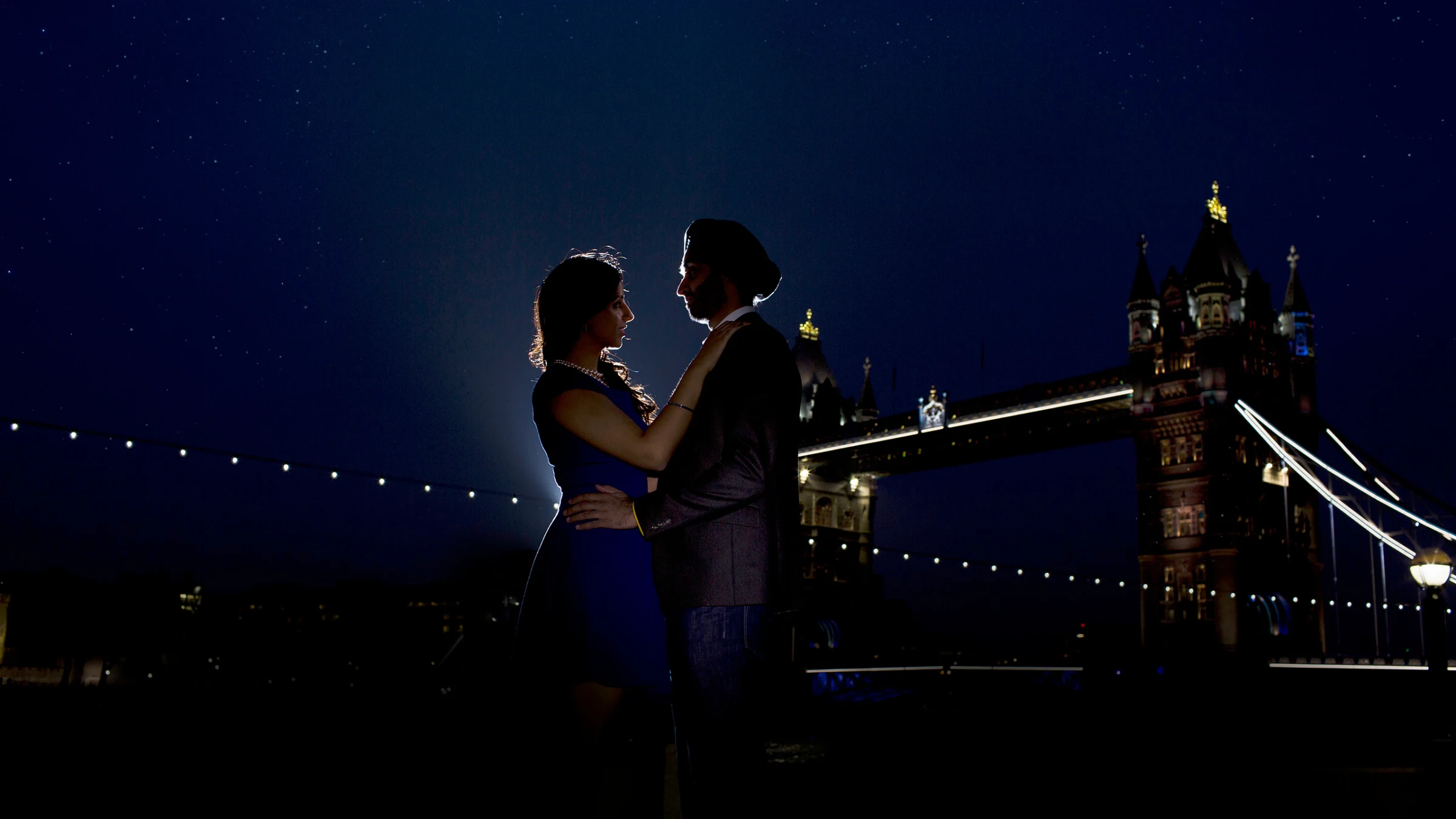
After sunset comes blue hour, a short spell of cool, even twilight that lasts until “civil dusk”, when the sun is six degrees below the horizon. It is lovely for portraits with lights behind you: a lit venue, a city street, festoon lights in a garden. After civil dusk, natural light for photographs is gone.
Golden hour and sunset times in London, month by month
Times are for London, rounded to the nearest five minutes, and calculated with the NOAA solar position method. They agree with sunrise-sunset.org to within a couple of minutes, and change by only a minute or two from year to year. Beckenham and north-west Kent are within about a minute of these times.
| Date | Golden hour starts | Sunset | Blue hour ends |
|---|---|---|---|
| 1 January | 3.00pm | 4.00pm | 4.40pm |
| 15 January | 3.25pm | 4.20pm | 5.00pm |
| 1 February | 4.00pm | 4.50pm | 5.25pm |
| 15 February | 4.25pm | 5.15pm | 5.50pm |
| 1 March | 4.55pm | 5.40pm | 6.15pm |
| 15 March | 5.20pm | 6.05pm | 6.40pm |
| 1 April | 6.50pm | 7.35pm | 8.05pm |
| 15 April | 7.10pm | 7.55pm | 8.30pm |
| 1 May | 7.35pm | 8.25pm | 9.00pm |
| 15 May | 7.55pm | 8.45pm | 9.25pm |
| 1 June | 8.15pm | 9.10pm | 9.55pm |
| 15 June | 8.25pm | 9.20pm | 10.05pm |
| 1 July | 8.25pm | 9.20pm | 10.10pm |
| 15 July | 8.20pm | 9.10pm | 9.55pm |
| 1 August | 8.00pm | 8.50pm | 9.30pm |
| 15 August | 7.35pm | 8.25pm | 9.00pm |
| 1 September | 7.05pm | 7.50pm | 8.20pm |
| 15 September | 6.30pm | 7.15pm | 7.50pm |
| 1 October | 5.55pm | 6.40pm | 7.10pm |
| 15 October | 5.20pm | 6.10pm | 6.40pm |
| 1 November | 3.45pm | 4.35pm | 5.10pm |
| 15 November | 3.20pm | 4.10pm | 4.50pm |
| 1 December | 2.55pm | 3.55pm | 4.35pm |
| 15 December | 2.50pm | 3.50pm | 4.30pm |
A few things stand out. The latest sunsets, around 9.20pm, fall in the second half of June. The earliest, around 3.50pm, come in mid-December, before the shortest day. And golden hour itself lasts about 45 minutes around March and September, and closer to an hour in June and December.
If your venue is far from London, look up its own sunset. Times shift with latitude and longitude, especially in the far north and west of the UK.
What happens when the clocks change?
The clocks move sunset by an hour overnight, and weddings either side of the change have very different evenings. According to GOV.UK:
| Year | Clocks go forward | Clocks go back |
|---|---|---|
| 2027 | 28 March | 31 October |
| 2028 | 26 March | 29 October |
In practice, a wedding in mid-March has a sunset around 6.05pm, and one in early April has a sunset around 7.35pm. At the other end of the year, sunset is around 6.10pm in mid-October and around 4.35pm by 1 November. If your date is the last Saturday of October or the first in November, check which side of the change you are on before you fix your ceremony time.
When to slip away from the wedding breakfast
Golden hour portraits take 10 to 15 minutes, so you won’t miss much. Where they fall depends on the month and your ceremony time. For a typical 1pm or 2pm ceremony:
| Months | Where golden hour falls | What to do |
|---|---|---|
| November to February | Mid-afternoon, soon after the ceremony | Portraits straight after the family photos |
| March and October | During the wedding breakfast | Slip out between the main course and dessert |
| April and September | After the meal, before or around the evening guests | Step out as the meal ends or before the first dance |
| May to August | Evening reception, around or after the first dance | Ten minutes away from the dance floor |
To make it easy on the day:
- Tell your caterer and MC or toastmaster. They can hold dessert for ten minutes or time an announcement around you.
- Pick the spot in advance. We walk the venue before the day or on arrival, so you walk straight there.
- Keep a short set after the ceremony too. If clouds roll in at golden hour, you already have portraits.
- Bring a layer. Summer evenings cool quickly after the sun drops.
If you are planning a winter date, the approach changes completely. Our guide to winter wedding photography in the UK shows how to build a day around a 3.50pm sunset, and our winter weddings page explains how we cover them.
What if it’s cloudy on the day?
It often is. In London, December averages only about 55 hours of sunshine for the whole month and July about 218, according to Met Office 1991 to 2020 averages for Heathrow, and even summer evenings can cloud over.
Cloud doesn’t spoil golden hour. It turns the sky into a giant softbox: even, flattering light with no harsh shadows and no squinting. You lose some of the warm glow, but the light still gets lower and softer as sunset approaches. And there is often a thin gap between cloud and horizon, where the sun breaks through for the last five or ten minutes. It is worth stepping out anyway.
If it is raining, we use doorways, covered terraces and clear umbrellas, or wait for the light just after a shower, which can be the best of the day. Our plan for rain on your wedding day covers it in full.
Golden hour on film
Golden hour matters for your film as much as your photographs. Backlight gives a glow around hair, veils and fabric, and movement looks better in soft, low light: walking together, a turn, a veil caught by the wind. Ten minutes at golden hour often gives us 20 or 30 seconds of a highlight film.
Light changes fast at this time of day, so the photographer and filmmaker work side by side rather than taking turns. The photographer guides a few moments, the filmmaker films them from a different angle, and you are back with your guests before the colour drains from the sky. After sunset, our cinema cameras cope well with blue hour and low light, so a short walk under festoon lights still looks warm on screen.
From behind the camera
The portraits couples love most are rarely the long, posed sessions. They are the ten minutes when the two of you step away from a loud room, catch your breath and see each other properly for the first time all day. Golden hour gives you an excuse to do exactly that.
What makes it work is planning. I always check the sunset for the date months in advance, look at the venue for where the sun will set, and agree a time with you and the venue’s coordinator. On the day, one of us keeps an eye on the sky and gives you a five-minute warning. If you feel awkward in front of a camera, this is the easiest light to be photographed in, and our guide to relaxing in front of a photographer and filmmaker has more on making it feel natural.
If you would rather do portraits before the ceremony, especially in winter, read whether a first look suits your day. You can see more about how we plan portraits on our wedding photography page.
FAQs
When is golden hour for wedding photos in the UK? Golden hour is roughly the last hour before sunset, when the sun is low and the light turns soft and warm. In London it starts around 8.25pm in late June and around 2.50pm in mid-December. Look up the sunset for your date and venue, then plan to step outside 45 minutes to an hour before it.
Do we have to miss our meal for golden hour photos? No. Golden hour portraits take 10 to 15 minutes. From April to September they usually fall after the meal or around the first dance. In March and October they can land during the wedding breakfast, so slip out between the main course and dessert, with your caterer and MC told in advance.
What if it is cloudy at golden hour? Cloud softens the light rather than ruining it, and it is often the most flattering light of the day. You may not get the warm glow, but skin looks even and nobody squints. If there is a gap in the cloud near the horizon, the sun can break through in the last few minutes, so it is still worth stepping out.
How long do golden hour photos take? Ten to fifteen minutes is enough for a set of relaxed portraits and a few moving shots for your film. We plan the location in advance, so you walk straight to it. Any longer and you miss your own party; any shorter and the light can slip past before you are ready.
Keep reading
- Wedding day timeline UK: sample schedules: see where golden hour fits into an 11am, 1pm or 3pm day.
- Winter wedding photography in the UK: what to do when the light goes before 4pm.
- How to plan your family photo list: keep the groups short so there is time for portraits.
Tell us your date and venue and we will look up your light and suggest where your portraits should fall. Check your date with us.