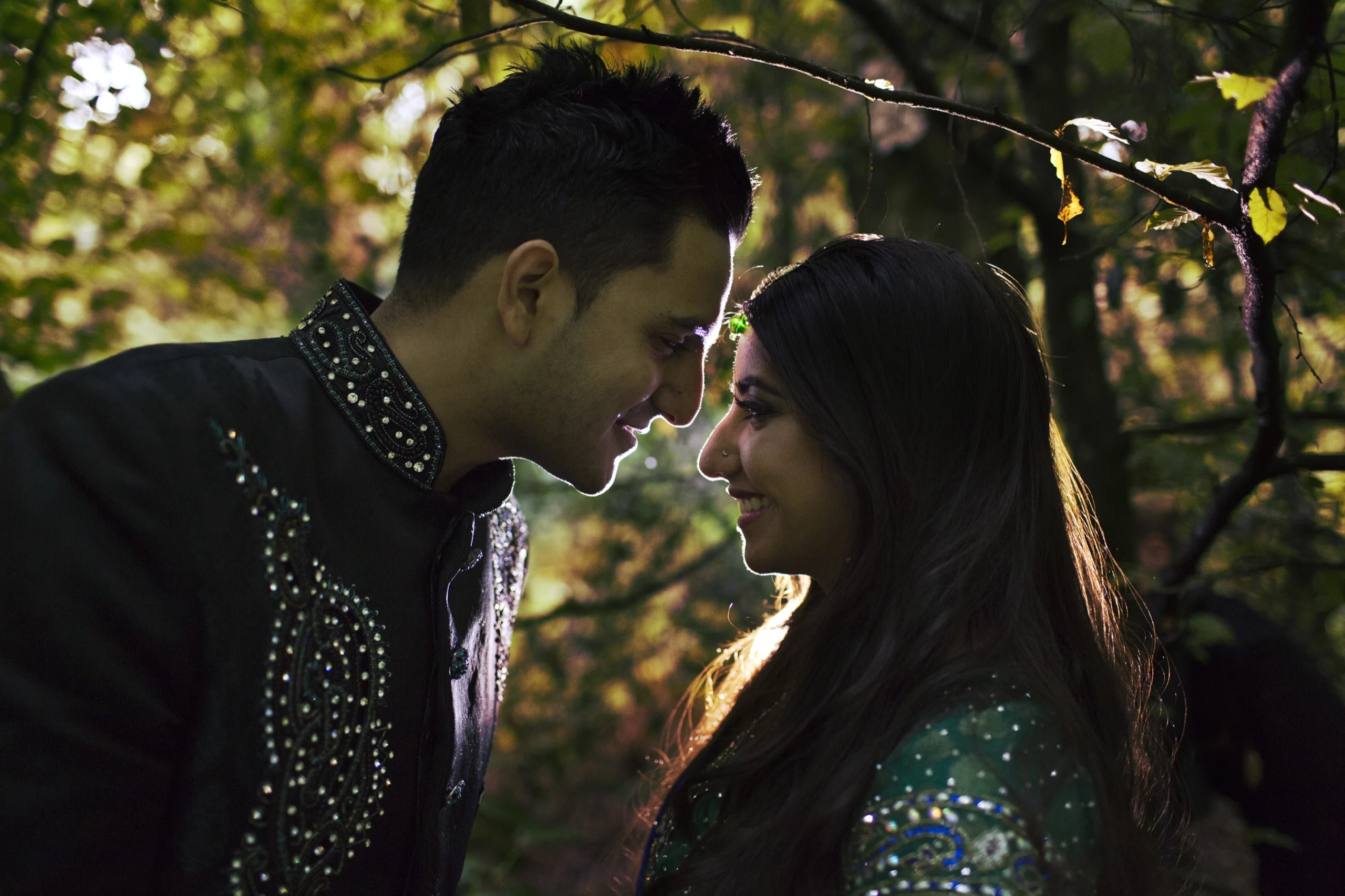
Almost nobody feels natural in front of a camera, and you don’t need to. Couples who look relaxed in their wedding photos are rarely posing well. They are usually being given something to do, and the photographer is catching what happens next. This guide covers why prompts work better than poses, how directing for film differs from photography, why an engagement shoot or a call helps, a 20-minute portrait plan, glasses, height differences and nerves on the day.
Portraits are only a small part of a wedding day. Our UK wedding day timeline guide shows where they fit around the ceremony, family photos and the meal.
Why do so many people feel awkward in photos?
Because most of us only see ourselves in photographs someone told us to stand still for. “Look here, smile” freezes a face at its least natural. Add a crowd of guests, a new outfit and the feeling that this one has to be good, and it is no wonder people go stiff.
The good news: on a wedding day you aren’t being asked to perform. Most of your photographs are documentary, taken while you are doing something else. The part where you are actually in front of the camera, just the two of you, is short.
Prompts vs poses: what’s the difference?
A pose tells you where to put your body. A prompt gives you something to do, and your body sorts itself out.
| A pose | A prompt |
|---|---|
| “Turn your shoulders towards each other and smile” | “Tell each other the first thing you’ll eat at dinner” |
| “Hold hands and look at the camera” | “Walk slowly to that tree and bump shoulders on the way” |
| “Look at each other lovingly” | “Whisper the moment in the ceremony you’ll remember most” |
| “Chin up, hold it” | “Forehead to forehead, close your eyes and breathe for three seconds” |
The prompt version gets a real reaction, usually a laugh, and the laugh is the photograph. We still guide the practical things, like where the light falls or which way to face, but we would rather you were talking to each other than thinking about your hands.
How is being filmed different from being photographed?
Couples often worry about film more than photographs, because they imagine being asked to act. In practice it’s the opposite.
- A photographer wants a moment. Sometimes that means pausing for a second, holding still in good light.
- A filmmaker wants movement. Walking, turning, a hand reaching for another, a laugh building. Stopping and smiling at the lens is the one thing that doesn’t work on film.
- Don’t look at the filmmaker. On film, eye contact with the lens feels like breaking the spell. Look at each other, at the view, at anything but the camera.
- You don’t have to say anything clever. Highlight films are mostly built on your vows, readings and speeches, recorded during the day. In portraits, your words are often not used at all, so chatting about anything you like is fine.
- Keep going. If you trip, laugh or kiss at the wrong time, carry on. Those are usually the best seconds.
When photography and film are from the same studio, we plan portraits together, so you aren’t asked to do everything twice. See our guide to booking your photographer and filmmaker together for why that helps on the day.
Do we need an engagement shoot?
For camera-shy couples, it is one of the most useful things you can do. An hour together before the wedding lets you learn how your photographer works, find out which prompts make you laugh, and see for yourselves that you look like you in their photographs. On the day, you arrive already used to the camera. Our guide to engagement shoots in London covers where to go and whether it’s worth it for you.
If an engagement shoot isn’t possible, a video call does much of the same job. Tell your photographer and filmmaker what worries you: a smile you don’t like, a side you prefer, a partner who freezes. We would far rather know. You can book a call with us at a time that suits you, and our list of questions to ask your photographer and videographer helps you check whether a studio is the right fit.
The 20-minute portrait plan
Our wedding photography is built around about twenty relaxed minutes of portraits, guided rather than posed, in the best light of the day. Here is how those twenty minutes usually go:
| Minutes | What happens | Why |
|---|---|---|
| 0–3 | Walk away from the guests together, no camera on you yet | Your shoulders drop once nobody is watching |
| 3–8 | Walking and talking prompts | Movement for film, real laughter for photographs |
| 8–13 | Closer portraits: forehead to forehead, a hand on a face, a whisper | The quieter, more emotional frames |
| 13–17 | Wider pictures with the venue or landscape | Shows where you were, with you small in the frame |
| 17–20 | A minute alone, with us at a distance | Often the most honest moments of the set |
You can take it as one block or split it in two: ten minutes after the ceremony and ten in the evening light. In June, golden hour in London starts at around 8.25pm, so evening portraits usually mean slipping out between courses. Our guide to golden hour wedding photos in the UK has the times for every month.
Tips for wearing glasses in wedding photos
- Wear them if you wear them every day. People know your face with them on.
- Anti-reflective lenses help if you are buying new ones before the wedding.
- Glare is the photographer’s job. Small changes in the angle of your head or the light solve most reflections. A slight tilt of the chin is often enough.
- Avoid lenses that darken in daylight if you can. They can turn dark outdoors and take time to clear inside.
- Don’t switch to contact lenses for the day unless you already wear them comfortably.
How to pose with a big height difference
Couples come in all heights, and nobody needs to crouch awkwardly. Some things that help, whatever your heights:
- Walk side by side. Height matters least in movement.
- Use steps, slopes and seats. One of you a step higher, or both of you sitting, evens things out naturally.
- The taller partner leans in, rather than the shorter one stretching up.
- Forehead to forehead or cheek to cheek works at any height difference.
- Camera height matters. Your photographer can shoot from a little lower or higher to balance the frame.
The same goes for family groups. Our guide to planning your family photo list covers how to keep those quick.
What helps with nerves on the wedding day?
- Eat. Hunger and nerves feel the same, and both show in your face.
- Keep the morning calm. A quiet, tidy room and time to spare help more than any posing tip. Our guide to getting-ready photos explains how to set it up.
- Consider a first look. Seeing each other privately before the ceremony takes the edge off for many couples. Our guide to first looks weighs up the pros and cons.
- Forget the camera during the ceremony. You will be focused on each other, which is exactly what we want to photograph.
- Tell us if something isn’t working. If you hate a pose or feel silly, say so. We will change it straight away.
From behind the camera
I always ask couples on our first call how they feel about being photographed, and the most common answer is a nervous laugh. That’s fine. What I’m listening for is what they do when they relax: who makes whom laugh, whether one of them goes quiet, whether they hold hands without thinking. Those are the things I’ll use as prompts on the day.
For film, the trick is distance. When the filmmaker steps back and uses a longer lens, couples forget they are being filmed within a minute or two, and that is when the footage turns real. Most of the portrait time is simply giving you space to be together on a day when everyone else wants a piece of you.
Frequently asked questions
How do I look natural in wedding photos?
Stop trying to look natural and give yourself something to do instead. Walk, talk, whisper, hold hands, look at each other rather than the camera. A good photographer gives you prompts, small actions or questions, and photographs what happens. Real reactions look natural because they are. Posing only for a few seconds at a time helps too.
Do we need an engagement shoot?
Not always, but it helps camera-shy couples more than anyone. An hour together before the wedding lets you learn how your photographer works, see that you look like yourselves in their photographs, and arrive on the day already used to the camera. If that is not possible, a video call does a lot of the same job.
How long do couple portraits take on the wedding day?
About twenty minutes is enough for a relaxed set of portraits and the shots your filmmaker needs. It can be one block or two short ones, for example ten minutes after the ceremony and ten in the evening light. Longer than that and most couples start to feel they are missing their own wedding.
Should I wear my glasses in my wedding photos?
If you wear them every day, yes. People know you with them, and you will look like yourself. Anti-reflective lenses help, and your photographer can manage glare by changing the angle of the light or asking you to tilt your chin slightly. Switching to contact lenses only for the wedding is best avoided unless you already wear them.
Keep reading
- Engagement shoots in London: the easiest way to get used to the camera before the day.
- Golden hour wedding photos in the UK: when the softest light falls, month by month, for your twenty minutes.
- 30 questions to ask your photographer and videographer: including how they work with couples who don’t like being photographed.
Talk it through first
If the camera is the part of the day you are dreading, tell us. Book a call and we will explain exactly how we work, so there are no surprises on the day.