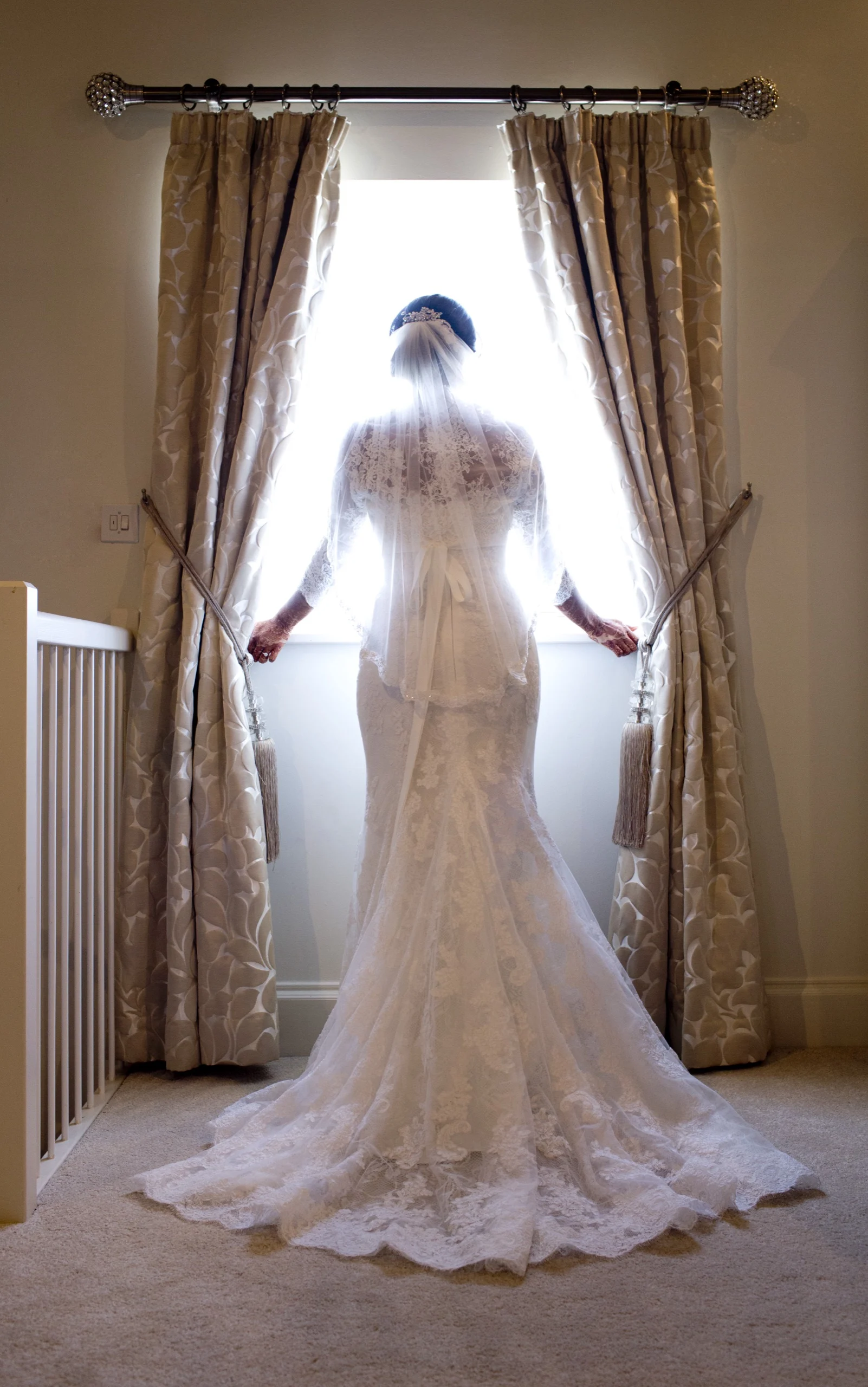
A first look is a private moment, planned before the ceremony, when you see each other for the first time on your wedding day, with only your photographer and filmmaker nearby. It suits winter weddings, nervous couples and anyone who wants their portraits done before the guests arrive. It doesn’t suit couples for whom the aisle is the moment, or families whose traditions keep the couple apart. Below: the pros and cons, a winter timeline, private vows, Jewish and other customs, a first look with a parent, and film.
The short answer: Have a first look if you want daylight portraits at a winter wedding, if nerves are getting the better of you, or if you want to spend the drinks reception with your guests. Skip it if the aisle reveal matters most to you, or if your tradition or family would rather you didn’t.
Where a first look fits depends on your whole day. Our UK wedding day timeline guide shows sample schedules for 11am, 1pm and 3pm ceremonies.
What is a first look, and how does it work?
One of you waits, back turned, somewhere quiet. The other walks up and taps a shoulder, and you turn round. What happens next is up to you: tears, laughter, a long hug, a few words nobody else hears.
A few things make it work:
- A private spot. A garden, an empty room, a quiet corner of the venue, away from where guests arrive.
- No audience. Bridesmaids and ushers can wait inside. Phones away.
- Time. About ten minutes for the moment itself, then your portraits straight after while you are both still glowing. Twenty relaxed minutes of portraits is usually enough.
First look pros and cons
| Pros | Cons |
|---|---|
| A private moment on a day spent mostly in public | You give up the first sight of each other at the aisle |
| Nerves settle once you are together | Getting ready has to start earlier |
| Portraits done in daylight, before the ceremony | Some families feel strongly about tradition |
| You can join your drinks reception and guests | The photographs can feel planned if the setting isn’t private |
| Couples often enjoy the ceremony more, having already had their moment | Not every venue has a quiet spot near the getting-ready rooms |
Does a first look spoil the walk down the aisle?
For most couples, no. The aisle moment changes rather than disappears. You have already had your private reaction, so the walk tends to be calmer, and you notice more: the faces of your guests, the music, the person waiting for you.
But if seeing each other in front of everyone is the picture you have had in your head for years, keep it. An earlier ceremony or a few minutes of blue hour can solve the light instead.
Some couples choose a middle way: no look, but a first touch. You stand either side of a door or a screen, hold hands without seeing each other, and talk, or read each other a letter. You keep the aisle reveal and still have a private moment.
Will it be dark for photos at a winter wedding?
Possibly, and this is where a first look earns its place. In mid-December, London sunset is around 3.50pm, and golden hour starts around 2.50pm. A 3pm ceremony leaves no daylight for portraits after it. Our winter planning rule is to finish the ceremony about 1 hour 45 minutes before sunset, and when that isn’t possible, because a church, a registrar or a religious calendar fixes a later time, a first look solves it.
Here is a 3pm ceremony in mid-December with a first look:
| Time | What happens | Photo and film notes |
|---|---|---|
| 11.30am | Photographer and filmmaker arrive | Details and preparations by the window |
| 12.45pm | Both dressed | Earlier than without a first look |
| 1.00pm | First look | Quiet spot outdoors or by a big window |
| 1.10pm | Couple portraits, about twenty minutes | Low December sun, soft all day |
| 1.30pm | Wedding party and close family groups | While the light holds |
| 2.00pm | You rest; guests begin to arrive | Microphones fitted for the ceremony |
| 3.00pm | Ceremony | No flash during the service |
| 3.40pm | Confetti in the last of the light | Sunset around 3.50pm |
| 3.50pm | Drinks and the rest of the family groups | Indoors, or a few minutes outside at blue hour |
Watch the clocks too: according to GOV.UK they go back on 31 October 2027, and sunset jumps an hour earlier overnight. Our guide to winter wedding light and timings has sunset times for every winter month, and our winter weddings page shows how we plan them.
In summer, light isn’t the reason: in June, golden hour in London starts around 8.25pm. A summer first look is about calm and time with your guests. For every month, see our guide to golden hour wedding photos in the UK.
Private vows and letters
A first look is a good moment for words you don’t want to say in front of a hundred people. Some couples read each other a letter or their own private vows, then make the formal vows in the ceremony.
On film, this can be the heart of the edit. Tell your filmmaker in advance, so a small microphone is on one of you before you meet. We film from a distance, and whether any of the words appear in your highlight film is your choice.
Jewish weddings: the bedeken comes first
At a Jewish wedding, the bedeken is the traditional first sight. The groom is led to the bride, usually with singing, looks at her and lowers her veil. In many traditional weddings it is the first time the couple have seen each other in days, and it is one of the most emotional moments of the day, witnessed by family and friends rather than in private.
Some couples, often in more liberal communities, see each other privately before the tisch and still hold the bedeken, so they can do portraits early and join the receptions. Others wouldn’t consider it. Your rabbi and your families are the right people to ask. Our Jewish wedding timeline shows when the portraits happen on each route.
Other traditions where couples don’t meet before the ceremony
Many families keep the couple apart until the ceremony, and the first sight of each other is shared with everyone:
- Some Hindu weddings hold a cloth called the antarpat between the couple, lowered during the ceremony before they see each other, a custom common in Gujarati weddings. Our guide to Hindu wedding photography moments covers it.
- At some South Asian weddings, the jaimala or the bride’s entrance is the moment the couple see each other, with both families watching.
- At some nikahs, the bride is in a separate room during the offer and acceptance.
Practice varies between families and communities. If you are thinking about a first look, ask your parents and your officiant first.
A first look with a parent
Not every first look is between the couple. Some of the most moving ones are with a parent:
- A father or mother seeing the bride or groom dressed for the first time, often just before leaving for the ceremony.
- A parent who won’t walk you down the aisle, or who won’t be at the front, who would love a moment of their own.
- A grandparent who can’t manage the stairs to the getting-ready room.
It takes five minutes and often gives the most honest reaction of the morning. Plan it in, and tell your photographer who it is with.
From behind the camera
The reaction lasts seconds. On film, that means everything is set before the couple meet: the filmmaker is in position with a long lens, sound is running, and the photographer has the other face. If we are both there, one of us covers each of you, so you get both reactions, not just the back of somebody’s head.
The best first looks are the ones nobody performs. We tell you where to stand, then step back and let it run. The moment after, when you stop looking at the outfit and start talking, is usually the frame couples love most.
Frequently asked questions
What is a first look at a wedding?
A planned, private moment before the ceremony when a couple see each other for the first time on the wedding day. One of you waits, usually facing away, and the other walks up. Only your photographer and filmmaker are there, at a distance. Many couples follow it with their portraits, so they are free to join their guests after the ceremony.
Does a first look ruin the moment at the aisle?
For most couples, no. The aisle moment changes rather than disappears: you have already had your private reaction, so the walk down the aisle tends to be calmer and you take in more of it. If seeing each other for the first time in front of everyone is the moment you have imagined for years, though, keep it.
Should we do a first look at a winter wedding?
It is one of the best reasons to have one. In mid-December, sunset in London is around 3.50pm, so a ceremony at 2pm or later can leave no daylight for portraits afterwards. A first look around midday or 1pm lets you do your portraits in daylight and keep the ceremony time you want.
Can we have a first look at a Jewish wedding?
Some couples do, and many don’t. In traditional weddings, the bedeken is the moment the couple see each other, often after days apart, and it is witnessed by family with singing. More liberal couples sometimes see each other privately first and still hold the bedeken. Talk to your rabbi before you plan it.
Keep reading
- Winter weddings in the UK: light, timings and photos: sunset times and ceremony times for every winter month.
- Jewish wedding timeline in the UK: tisch, bedeken, chuppah and yichud, with clock times.
- Camera-shy? How to relax in front of a photographer and filmmaker: if nerves are the reason you are thinking about a first look.
Plan it with us
If you are weighing up a first look, send us your ceremony time and we will suggest a timeline around the light. See how we cover the day on our wedding photography page, or book a call.