A register office wedding is short, often 15 to 30 minutes in the ceremony room, and the rules on photography vary from council to council. Some let your photographer and filmmaker record the whole ceremony, some restrict it, and many don’t allow photos of the real signing but stage a posed one afterwards. This guide explains the rules, answers whether you can photograph the signing, and sets out a two-hour plan that makes the most of a short ceremony.
The short answer: Ask your registration service what it allows during the ceremony and the signing, arrive at least 30 minutes early, and plan the steps outside and a short portrait walk nearby. Two hours of coverage is usually enough.
For how civil rules compare with church, gurdwara, mosque and synagogue weddings, see our guide to photography and filming rules for every UK ceremony.
How long is a register office wedding ceremony?
The ceremony itself is short: often around 15 to 30 minutes in the room, including the signing, and a simple ceremony in the statutory room can be quicker still. The visit is longer. Registrars usually see the couple briefly beforehand to check details, and you will want time outside afterwards.
The legal essentials: you give notice at your local register office at least 29 days before the ceremony, you need at least two witnesses, and nothing religious is allowed, though a religious blessing afterwards is fine. A statutory-room ceremony is £62 from April 2026 (some councils quote £74.50, which includes the £12.50 certificate); larger rooms and approved venues cost more, so check with your local register office. Our guide to getting married legally in England and Wales has the full process.
Can you take photos in a registry office?
Usually, but the rules belong to each council. Some examples, from the councils’ own pages:
| Council | What it says about photography |
|---|---|
| Surrey | A photographer or videographer may record the ceremony |
| Southend | Restricted: the registrar tells you when photos can be taken |
| Croydon | Photography is not permitted during the ceremony |
| Oxfordshire | Strongly recommends not photographing while the schedule is signed |
| Wrexham | Photos are allowed after the signing |
So two London boroughs, or two neighbouring counties, can take opposite views. The same registration service conducts civil ceremonies at approved venues in its area, so its rules usually apply at your hotel or country house too, though the venue may give us more room to move.
Even where filming is allowed, a registrar may ask that the legal declarations, or the signing, aren’t filmed. We check with the registrar on the day, introduce ourselves before the ceremony, and work within whatever they ask. We never use flash during the ceremony.
Can you photograph the signing of the register?
This is the question couples ask most, and the honest answer is: sometimes, and you should plan for the times you can’t.
What you actually sign. Since 4 May 2021, couples in England and Wales sign a marriage schedule (or marriage document) instead of a register book, and the details go onto an electronic register. Each of you can now list up to four parents. People still call it “signing the register”, and it is still one of the photographs families most want.
Why it’s restricted. There’s no national ban. Restrictions are local policy and the registrar’s discretion. The reason often given is the personal details recorded on the document.
What councils do. Oxfordshire strongly recommends not photographing while the schedule is signed. Wrexham allows photos after the signing. Many registrars stage a posed signing once the real paperwork is complete.
How to make the posed signing work.
- Ask in advance whether your registrar offers a posed signing, and how long they allow for it.
- Decide who’s in it. You two, then your witnesses, then perhaps parents. Tell your photographer the order.
- Keep it moving. The next couple may be waiting, so three or four set-ups is plenty: the two of you signing, a close-up of hands and rings, the witnesses, and one with the registrar if they’re happy to be photographed.
- Look at each other, not the camera. A posed signing looks natural when you talk to each other while one of you signs.
- Bring a good pen if you’d like one in the photographs. Some couples keep it afterwards.
A posed signing is often better than the real one: calmer, better lit, and nobody is concentrating on spelling a parent’s middle name. In a church, the rules are usually more relaxed: see church wedding photography and filming rules.
Arrival, slots and guests
Register offices run to a timetable, and in a busy London town hall the next couple is often waiting in the hall. A few things make the difference:
- Arrive at least 30 minutes early. Registrars usually see the couple before the ceremony, and late arrivals can shorten your slot.
- Ask about guest numbers. Statutory rooms can be very small, sometimes little more than the couple and two witnesses, while larger rooms hold more at a higher fee. Count your photographer and filmmaker in the numbers.
- Ask about confetti. Some register offices allow it on the steps, some don’t, and some only allow petals.
- Gather everyone outside before you go in. Guests arriving is a set of photographs in itself, and there’s rarely time to round people up afterwards.
A two-hour coverage plan
Two hours is our minimum coverage and is often all a register office wedding needs: see our civil ceremony weddings. This example is for a 12:00 ceremony; move every time to suit yours.
| Time | What happens | Photo and film |
|---|---|---|
| 11:15 | We arrive; guests start gathering | Arrivals, the building, family as they come in |
| 11:35 | You arrive | Your arrival, the last few minutes of nerves |
| 11:45 | Registrars see you before the ceremony | Quiet portraits of guests waiting |
| 12:00 | Ceremony | Entrance, vows, rings and the first kiss, within the registrar’s rules |
| 12:20 | Signing, or a posed signing | You two, witnesses, close-ups |
| 12:30 | Out onto the steps | Exit, confetti, hugs |
| 12:40 | Family and group photographs | Five to eight groups, kept short |
| 12:55 | Portrait walk nearby | Twenty relaxed minutes of the two of you |
| 13:15 | Coverage ends, or we follow you to lunch | Add hours for toasts and speeches |
If you’re going on to lunch or a party, add the hours you need. Our guide to planning your family photo list helps keep the groups on the steps to ten minutes.
The steps outside and a portrait walk nearby
The steps are where register office weddings come alive. Everyone is out, the ceremony is done and the confetti comes out. We line guests on both sides, ask you to walk slowly, and usually do it twice.
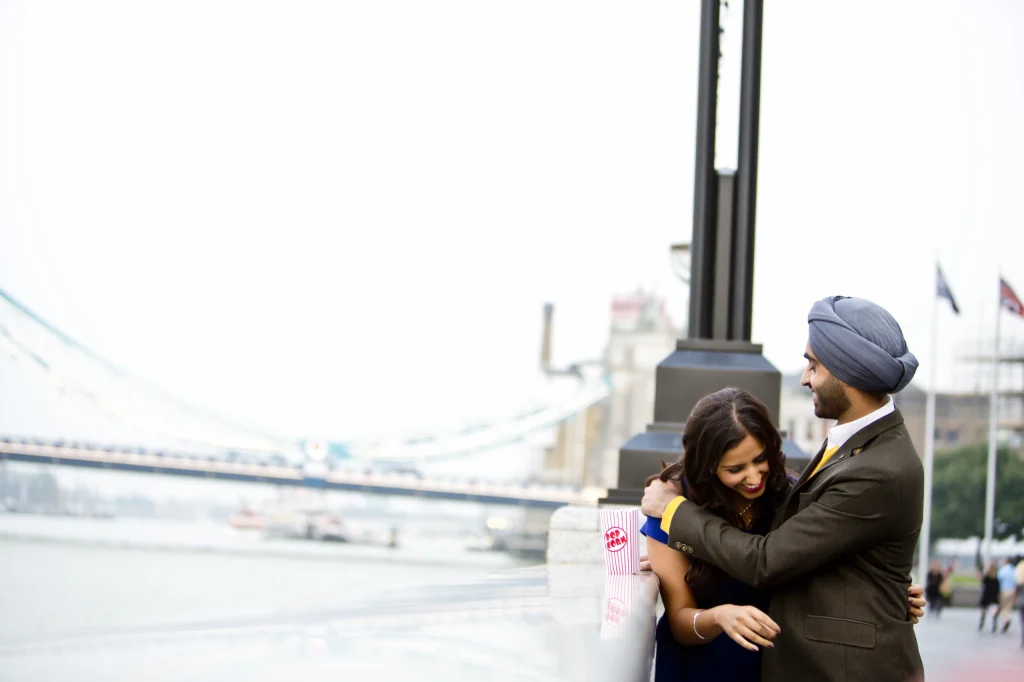
Then we take you away for twenty minutes. In London that might be a garden square, a quiet side street, a church wall or a bridge, within a five-minute walk. Quick, informal portraits on public streets usually don’t need permission, but some parks, landmarks and private estates have their own rules, so we check your spots beforehand. For ideas around central London, see London city weddings, from register office to reception and our city weddings page.
A register office wedding is often the legal half of a larger celebration, such as a Sikh, Hindu or Muslim ceremony on another day, and we can cover both. If it’s just the two of you and two witnesses, read our guide on how to elope in the UK.
From behind the camera
Register offices reward preparation more than any other kind of wedding. With a 20-minute ceremony there is no second chance at the rings, so before the doors open I ask the registrar three things: where they would like us to stand, whether we can photograph and film throughout, and how they handle the signing. Then I pass the answers to our filmmaker before you arrive.
On film, the challenge is sound: voices are quiet, so a small microphone, agreed with the registrar, makes the difference between vows you can hear and vows you can only see. On the steps, I keep family groups moving, because the guests’ patience and the next couple’s arrival tend to run out together.
Frequently asked questions
How long is a registry office wedding ceremony?
The ceremony itself is short: often around 15 to 30 minutes in the room, including the signing, and a simple ceremony in the statutory room can be quicker still. Allow longer for the whole visit, because registrars usually see the couple before the ceremony to check details, and you will want time on the steps afterwards for confetti and photographs.
Can you photograph the signing of the register?
It depends on the council and the registrar. Some allow photos of the real signing, some recommend against it or allow photos only afterwards, and many registrars stage a posed signing once the paperwork is done. There is no national ban. Ask your registration service when you book, and plan the posed signing into your timings.
Do I need a photographer for a registry office wedding?
You don’t need one, but a short ceremony passes quickly and guests with phones rarely catch the vows, the rings and the signing together. A photographer for two hours covers arrivals, the ceremony, the signing, confetti on the steps, family groups and a short portrait walk. If you want to hear your vows again, a short film adds that.
How many guests can we invite to a register office wedding?
It depends on the room. Register offices usually offer a small statutory room, sometimes for little more than the couple and two witnesses, and larger ceremony rooms that hold more guests at a higher fee. Ask your register office for each room’s capacity before you send invitations, and count your photographer and filmmaker in the numbers.
Keep reading
- Can you take photos during the ceremony? UK rules for every kind of wedding: how civil rules compare, with an email template for your registrar.
- London city weddings: register office to reception: portrait spots and timings for a day in town.
- How to elope in the UK: two witnesses, a register office and photographs that still feel like a wedding.
Planning a register office wedding? Midweek dates are often the easiest to book, and our Monday to Thursday rates are lower. Get a price for your date.