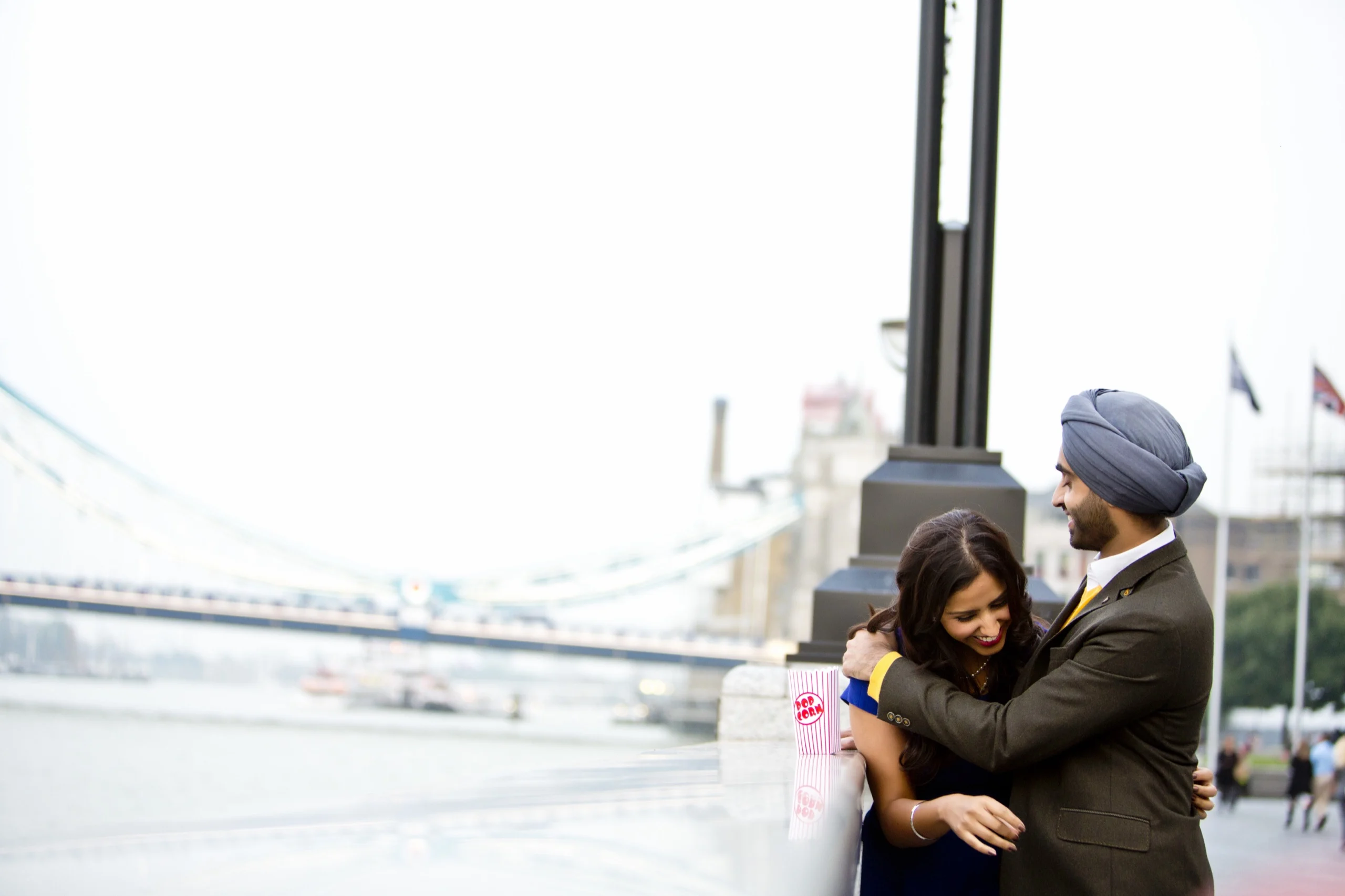
A London city wedding usually means a ceremony at a town hall, church or hotel, a short portrait walk on nearby streets, and a journey across town to the reception. This guide covers where to stop for photos, how long to allow for travel, London light and crowds, permissions, a sample timeline and a plan for rain.
The short answer: Keep your portrait spots within a five-minute walk of the ceremony, allow a buffer of 15 to 20 minutes on every journey, and plan a few minutes outside after dark. Six to ten hours covers a full city day; two hours covers a register office ceremony and portraits.
Whatever your ceremony, the rules on photography belong to the place you marry: see our guide to photography and filming rules for every UK ceremony before you plan the rest of the day.
What does a London city wedding day look like?
Most city weddings we photograph follow the same shape, whatever the culture: getting ready in a hotel suite or at home, a black cab or a walk to the ceremony, the steps and a twenty-minute portrait walk, then drinks, dinner, speeches and the first dance, with a few minutes outside after dark.
The ceremony is often at one of London’s town halls. Chelsea Old Town Hall, Marylebone, Islington and Westminster each have their own character and rules, and the next couple is often waiting in the hall. Our guide to register office wedding photography explains what each council allows during the ceremony and the signing. Still choosing a reception? Start with our guide to wedding venues for hire across London.
Where can you take wedding photos near a London register office?
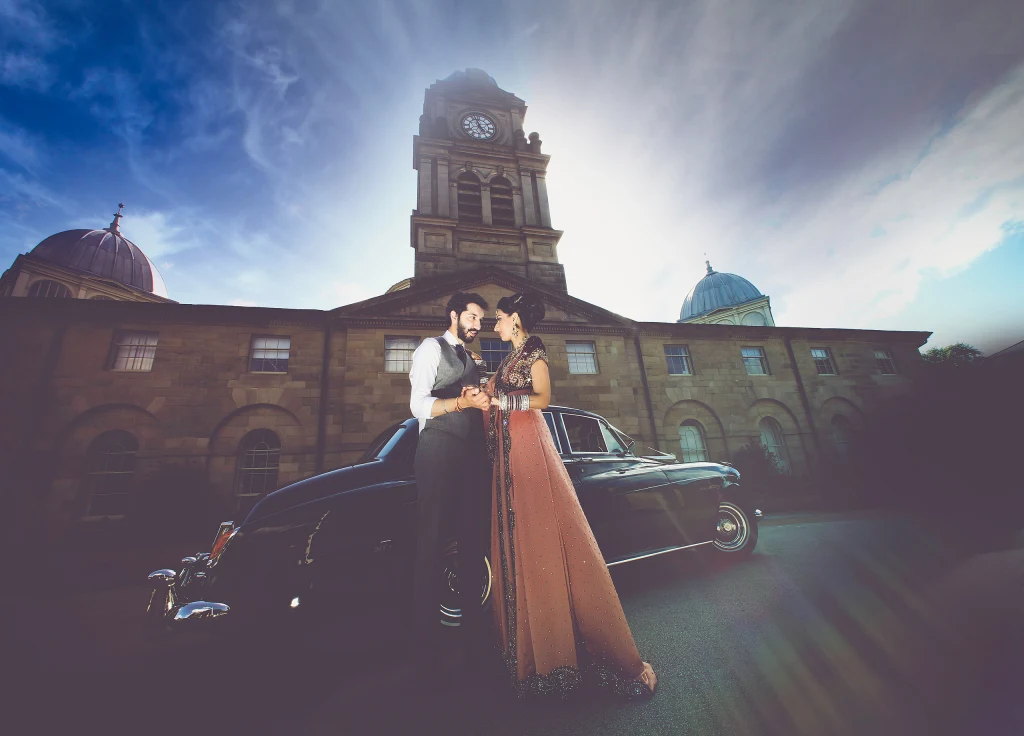
The best city portraits are rarely at the famous landmarks. They are on the street around the corner, a five-minute walk from where you married, which keeps you away from your guests for twenty minutes rather than an hour.
What we look for around a ceremony venue:
- The steps and doorway of the town hall, before and after the confetti.
- A garden square with trees, railings and quieter pavements.
- A side street with painted doors, brick or stucco.
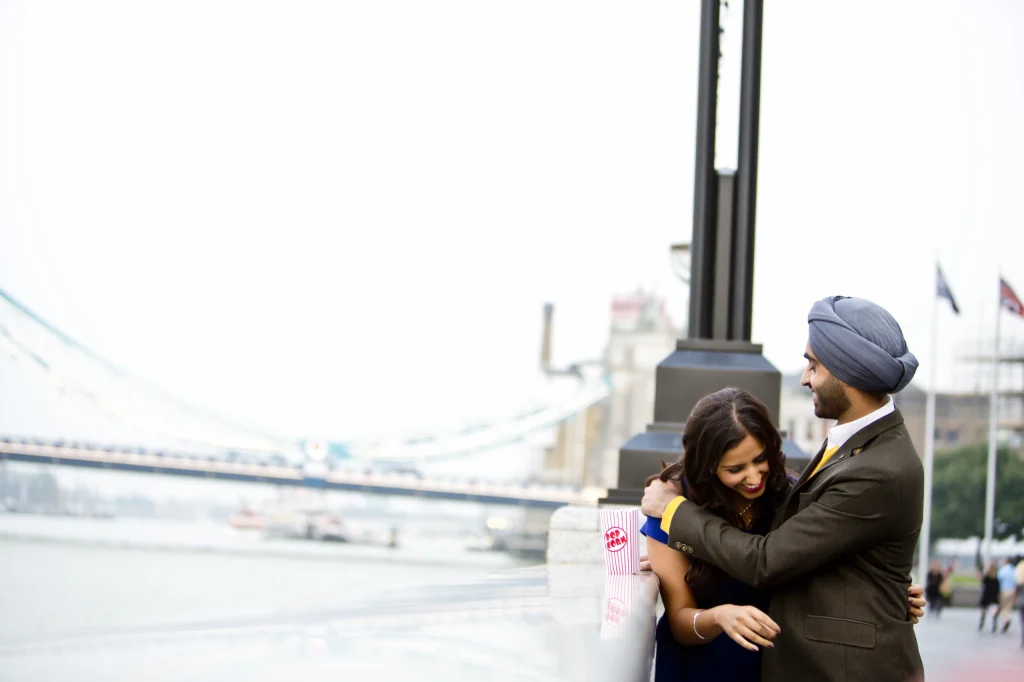
- A church wall, a covered arcade or a bridge, for texture, shelter or sky.
- Shop windows and lit doorways, which come into their own after dark.
Around Chelsea Old Town Hall, for example, the King’s Road and the streets behind it give you plenty within a few minutes on foot. We walk the area before the day. For a longer session on another day, try an engagement shoot in London.
Do you need permission for wedding photos in London?
For quick, informal portraits on a public street, usually not. That changes with the land you are standing on:
| Kind of place | What to expect | What to do |
|---|---|---|
| Public street or pavement | Quick portraits are usually fine | Keep the pavement clear for passers-by |
| Garden squares | Some are private and open only to residents | Check whether the square is public before you plan on it |
| Parks | Rules differ between park managers | Check with the landowner, whether a borough council, the Royal Parks or a trust |
| Landmarks and private estates | Many have their own rules for photography or filming, and some charge | Check with the landowner well before the day |
| Stations, shopping centres, office plazas | Private land, even when it feels public | Ask the owner or manager; expect to be moved on otherwise |
| Your venue’s grounds | The venue decides | Ask your venue coordinator |
If a spot needs permission, we tell you in advance and keep a second option nearby. Drones have their own aviation rules: see our guide to drone wedding filming in London and Kent.
How long does it take to travel between places in London?
Longer than the map suggests, especially on a Saturday. Traffic, road closures for events and marches, and getting thirty guests out of one building and into another all add time.
- Add a buffer of 15 to 20 minutes to every journey, on top of the journey planner.
- Keep the ceremony and reception close if you can. One cab ride is far easier than crossing the river at 3pm on a Saturday.
- Give guests directions and a time, so nobody waits at the reception door for you.
- Let us travel ahead. With photo and film booked, one of us often goes ahead to film the room filling up.
Travel is included within 50 miles of our studio in Beckenham, which covers the whole of London.
London light and crowds: what to expect
Tall buildings put streets into soft shade early in the afternoon, which flatters faces, and glass and pale stone bounce light back in. The harder moments are midday sun between buildings and dark ballrooms or basement restaurants, where we bring quiet lighting and film on cinema cameras that handle low light well.
The light most couples remember is after dark: shop windows, street lamps and passing taxis. In summer that happens late: London sunset is around 20:45 in mid-May and around 21:20 in late June, so night portraits fall after the first dance. In winter it comes early: sunset is around 15:50 in mid-December, so a 13:00 ceremony leaves time for daylight portraits, and the streets are lit by the time drinks begin. Our guides to golden hour times month by month and winter wedding photography have the full tables.
Crowds are part of the city. Choose side streets over shopping streets and landmarks, go early or after dark, and keep moving rather than waiting for a street to empty. A couple in sharp focus with the crowd softly behind is a classic city photograph.
A sample London city wedding timeline
A Saturday in mid-May, with a 13:00 town hall ceremony and a reception across town. Move every time to suit your day.
| Time | What happens | Photo and film |
|---|---|---|
| 10:30 | We arrive at the hotel suite or home | Getting ready, details, window-light portraits |
| 12:15 | Leave for the ceremony | The car or cab, the last look back |
| 12:30 | Arrive at the town hall; guests gather | Arrivals and family as they come in |
| 13:00 | Ceremony | Vows, rings and the first kiss, within the registrar’s rules |
| 13:25 | Signing, or a posed signing | You two, witnesses, close-ups |
| 13:35 | Steps, then family groups | Confetti, then five to eight groups, kept short |
| 14:00 | Portrait walk nearby | Twenty minutes on nearby streets and squares |
| 14:25 | Travel to the reception | Moments in the car; one of us goes ahead |
| 15:00 | Drinks reception | Guests, candids, the room before anyone sits down |
| 16:30 | Wedding breakfast, then speeches | Every word recorded, reactions photographed |
| 19:55 | Golden hour | Ten minutes outside, close to the venue |
| 20:30 | First dance | The dance and the dance floor |
| 21:15 | Night portraits | A few minutes on the street under the lamps |
| 21:30 | Coverage ends |
That is about eleven hours; start later or finish after the first dance to fit ten. Our family photo list guide helps keep the groups on the town hall steps to fifteen minutes.
What’s the rain plan for a city wedding?
Rain is likely enough to plan for. Met Office averages for London Heathrow (1991 to 2020) show around eight rain days a month in May, July and September, and around eleven in October and November. Even in summer, roughly one day in four is wet.
The city is kinder to rain than the countryside, because cover is everywhere: porticos, arcades and deep doorways for dry portraits, a staircase or lobby at the venue, and clear umbrellas that keep faces visible. For film, rain mostly affects sound, so vows and speeches stay indoors. See our rainy wedding day plan for photo and film.
From behind the camera
The city rewards a recce more than anywhere else. Before a London wedding I walk the streets around the ceremony on the same day of the week as the wedding, because a quiet square on a Tuesday can be a market on a Saturday. I note where the shade falls, where we can shelter, and two backup spots.
On the day, the car matters more than couples expect. A black cab is a lovely small space for photographs and a few seconds of film, but only if we know where it will stop, so we agree the drop-off with the driver: you step out where the light is good, not in front of a bus stop. After dark, I keep night portraits to five minutes on the pavement, then you are back inside before the next song.
Frequently asked questions
Do you need a permit for wedding photos in London?
For quick, informal portraits on a public street, usually not. Some parks, landmarks, private squares and estates have their own rules for photography or filming, and some charge. Who manages a space isn’t always obvious, so check with the landowner. We look at your spots in advance and tell you if one needs permission.
How long should we allow between the register office and the reception?
Allow longer than the journey planner suggests, especially on a Saturday: about 20 minutes for the portrait walk, then the journey plus a buffer of 15 to 20 minutes for traffic and road closures. Give guests clear directions and a time to arrive, so drinks start on time.
What happens to our London wedding photos if it rains?
We use the cover the city gives you: porticos, arcades, hotel entrances and doorways, with clear umbrellas in between. After dark, wet streets reflect shop windows and street lamps, which can make the best night portraits of the day. Met Office averages show eight to eleven rain days a month in London.
Keep reading
- Register office weddings: great photos in 30 minutes: council rules, the signing and a two-hour plan.
- How to elope in the UK: two witnesses, a town hall and a city walk.
- Golden hour wedding photos in the UK: when the best light falls, month by month.
Planning a wedding in town? See how we cover London city weddings and civil ceremonies, then get a price for your date.