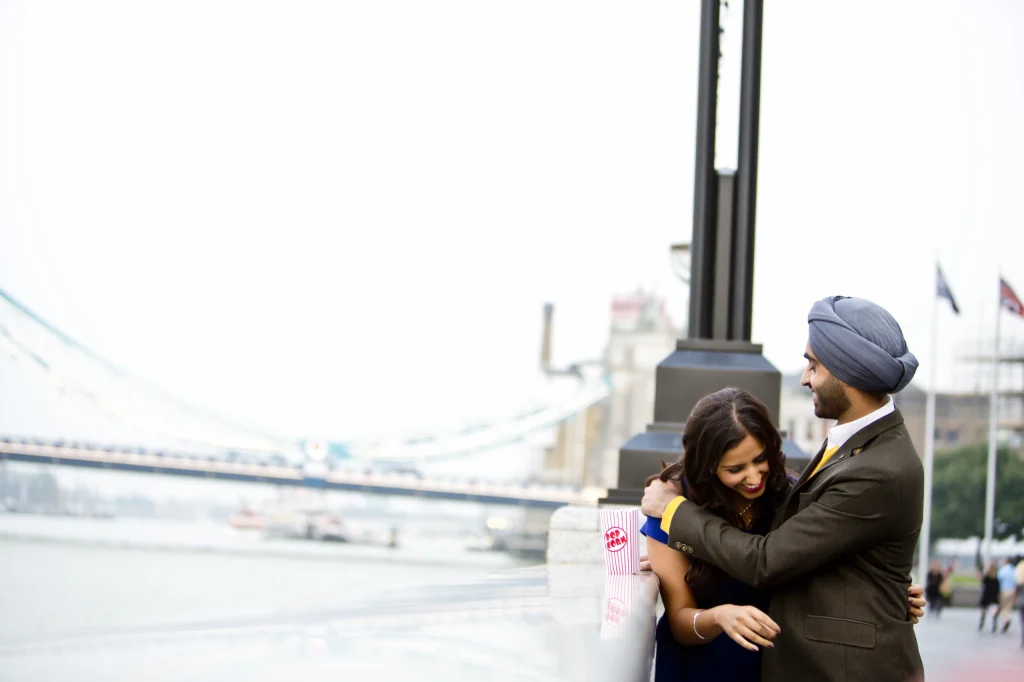
To elope legally in England or Wales, you both give notice at your local register office at least 29 days before the wedding, then marry at a register office or an approved venue, in front of a registrar and two witnesses. That is the whole legal minimum. Everything else, from who comes to where you go afterwards, is up to you.
This guide covers the legal steps and fees, the “two plus two” wedding, photo spots in London and Kent, how much coverage you need, and telling your family. For what you can photograph during the ceremony itself, see our guide to ceremony photography rules in the UK.
What does eloping mean in the UK?
In films, eloping means running away and marrying the same day. In England and Wales you can’t do that, because notice has to be given weeks in advance. Here, eloping usually means a wedding with just the two of you and two witnesses, or a handful of the people closest to you, and no big reception.
You wouldn’t be alone in choosing small: according to Bridebook’s UK Wedding Report 2026, 41% of receptions have fewer than 60 guests.
How do you elope legally in England and Wales?
These are the steps, with the statutory fees that apply from 6 April 2026. Fees change each April, so check with your register office before you book.
| Step | When | What it involves | Fee |
|---|---|---|---|
| 1. Book your ceremony | First | Choose a register office or approved venue. The venue is named on your notice, so book it before you give notice. | Register office statutory room: £62 from April 2026, plus £12.50 for the certificate (some councils quote £74.50 including it). Approved-venue fees are set by each council and are much higher. |
| 2. Give notice | At least 29 days before the wedding | Both of you, by appointment, at your local register office. You must each have lived in that district for the past 7 days. If you live in different districts, you each give notice in your own. | £46.50 each, £93 for the two of you |
| 3. Find two witnesses | Before the day | Two people to see you marry and sign the marriage schedule. Most couples ask a friend or family member each. | None |
| 4. Get married | Within 12 months of notice | A registrar conducts the ceremony. You exchange vows and sign the marriage schedule with your witnesses. | Included above |
| 5. Order your certificate | On the day or after | Your official copy of the marriage record | £12.50 standard |
A few points to know:
- If one of you isn’t a British or Irish citizen (and doesn’t have EUSS settled or pre-settled status), you give notice together, and the Home Office can extend the notice period to 70 days.
- You must both be 18 or over.
- Civil ceremonies can’t be religious. Readings and music are fine; a religious blessing afterwards is allowed.
Some councils quote £74.50, which includes the £12.50 certificate. Our guide to getting married legally in England and Wales has the full detail.
What is a “two plus two” wedding?
It is the two of you plus your two witnesses, and it is the cheapest legal way to marry. In a register office statutory room, the statutory fees come to roughly £170 from April 2026: £93 for notice, £62 for the ceremony and £12.50 for a certificate. A larger room or a weekend slot can cost more, so check your council’s fee table.
Can you elope outdoors in the UK?
In England and Wales, only within the grounds of approved premises. Outdoor civil ceremonies were made permanent from 6 April 2022, and marquees and other semi-permanent structures count, but the spot must be agreed with the superintendent registrar. A beach, a field or a clifftop outside a licensed venue’s grounds is not a legal wedding venue. Some councils also limit outdoor ceremonies to British Summer Time.
Scotland is different. Its system is based on the celebrant rather than the building, so religious and belief celebrants, including humanists, can marry couples almost anywhere, including outdoors. You give notice to the registrar in the district where you will marry, no later than 29 days before.
How much photography and film does an elopement need?
Less than you might think. Our coverage starts at two hours, usually plenty for a register office wedding:
| Time | What we cover |
|---|---|
| 13:30 | We arrive before you, find the light and photograph your witnesses and guests gathering |
| 13:45 | Your arrival |
| 14:00 | The ceremony and signing, quietly and within the registrar’s guidance |
| 14:25 | Confetti on the steps, then five or six family photos |
| 14:45 | A relaxed walk to a nearby street or garden square for portraits |
| 15:30 | Done, or on to lunch with us if you add time for the toasts |
Rules on photographing the ceremony and signing vary between register offices, and many registrars stage a posed signing afterwards. Our guide to register office wedding photography explains how to get great photos in a short slot.
If you want to hear your vows again, a simple wedding film is made for days like this: one filmmaker, up to four hours, your ceremony in full with clean audio from small, discreet microphones, any speeches uncut, and a two to three minute highlight film, delivered within four weeks.
Where should you go for elopement photos in London and Kent?
The best spots are almost always within a short walk of your ceremony. In London, look for:
- Town hall steps, for confetti and your first photos as a married couple
- Garden squares and quiet streets, for unhurried portraits
- Riverside paths and bridges, especially in late afternoon light
- The restaurant where you will eat, for the toasts
In Kent, you have more space to wander:
- The grounds of your approved venue, often the easiest option
- Country lanes, orchards and woodland edges nearby
- The coast, if you are happy to travel after the ceremony
Quick, informal portraits on public streets usually need no permission, but some parks, landmarks and private estates have their own rules for photography or filming. We check your chosen spots before the day. See our London city weddings guide for more on portraits in town.
Think about the light. In mid-October, sunset in London is around 18:10, so a 14:00 ceremony leaves plenty of time. In mid-December it is around 15:50, so book a ceremony around midday or early afternoon. Our golden hour guide gives the times month by month.
How do you tell your family you eloped?
There is no single right way, but a few things help:
- Tell the people closest to you before you post online.
- Share a few photos or a short film first. Seeing your faces in the moment often turns surprise into happiness.
- Consider inviting parents as your witnesses. It is still an elopement, and it can mean a great deal to them.
- Be aware of what the wedding means to your family. In many cultures, family expect to be part of the wedding, and a later celebration can bring everyone in.
Can you have a celebration later?
Yes. A legal ceremony now can be followed by a party, a religious blessing, a nikah or a larger cultural celebration later. If your family has two traditions, our guide to fusion weddings with two ceremonies explains how couples plan them. We can cover both, so they sit together in one gallery and one film. See how we approach intimate weddings and elopements and civil ceremonies.
From behind the camera
At a two plus two wedding, everything is right in front of the camera: the way your hands shake on the pen, the look your witness gives you during the vows. There are no crowds to work around, so we can stay further back and let the moment be yours.
What catches couples out is time. Register office ceremonies run to the minute, and the next couple is often waiting. We arrive early so your arrival and the nervous minutes outside are covered before the doors open. For film, we put a small microphone on you before you go in, because in a quiet room every word of your vows is worth keeping.
Frequently asked questions
What is the cheapest way to get married in the UK?
In England and Wales, the lowest-cost legal wedding is a ceremony in a register office’s statutory room with two witnesses. From April 2026 the statutory fees come to roughly £170: £46.50 each to give notice, £62 for the ceremony and £12.50 for a certificate. Fees change each April and vary for approved venues, so check with your register office.
How far in advance do you need to give notice of marriage?
In England and Wales, you give notice at your local register office at least 29 days before the ceremony, which GOV.UK describes as 28 clear days. Notice given on 1 May means the earliest wedding date is 30 May. Notice is valid for 12 months, and you need to have lived in the district for the past 7 days.
Do I need a photographer for a register office wedding?
You don’t have to have one, but with a tiny wedding there are fewer phones and fewer people to remember the day for you. Two hours is usually enough to cover arrivals, the ceremony, the signing, confetti, a few family photos and relaxed portraits. Each registrar has their own rules on photography, so we always check on the day.
Can our photographer be one of our witnesses?
It is best to bring two witnesses of your own. A photographer who is signing the schedule isn’t photographing the moment, and some register offices have their own rules about who can act as a witness. If finding two witnesses is difficult, ask your register office what they allow well before the day.
Keep reading
- Register office weddings: great photos in 30 minutes: how to make a short ceremony slot count.
- Getting married legally in England and Wales: the full guide to notice, fees and religious weddings.
- London city weddings: portrait spots and timings between a register office and your meal.
Planning something small? Check your date and we will tell you straight away whether we are free, or see how our collections work.