You can often film a wedding with a drone in the UK, as long as the operator follows the Civil Aviation Authority’s rules, keeps a safe distance from your guests, stays out of restricted airspace and has the venue’s permission. In the Kent countryside that is often straightforward; in central London it often isn’t possible. This guide explains the CAA rules in plain terms, the checks we make, and when aerials are worth it.
The short answer: A drone at a wedding needs a properly registered and insured operator, the venue’s permission, and airspace that allows it. It must stay below 120m, in sight, and never fly over a crowd of guests. Rural venues often work; many central London venues don’t. Check the current CAA rules before you plan on it.
The officiant’s rules on the ceremony apply to the sky above it too: see our guide to photography and filming rules for every UK ceremony.
The rules below come from the CAA’s Drone and Model Aircraft Code (CAP2320, March 2026) and the CAA’s drone pages, checked on 20 October 2026. They changed on 1 January 2026 and are updated regularly, so check the current CAA rules before any flight.
What do drone shots add to a wedding film?
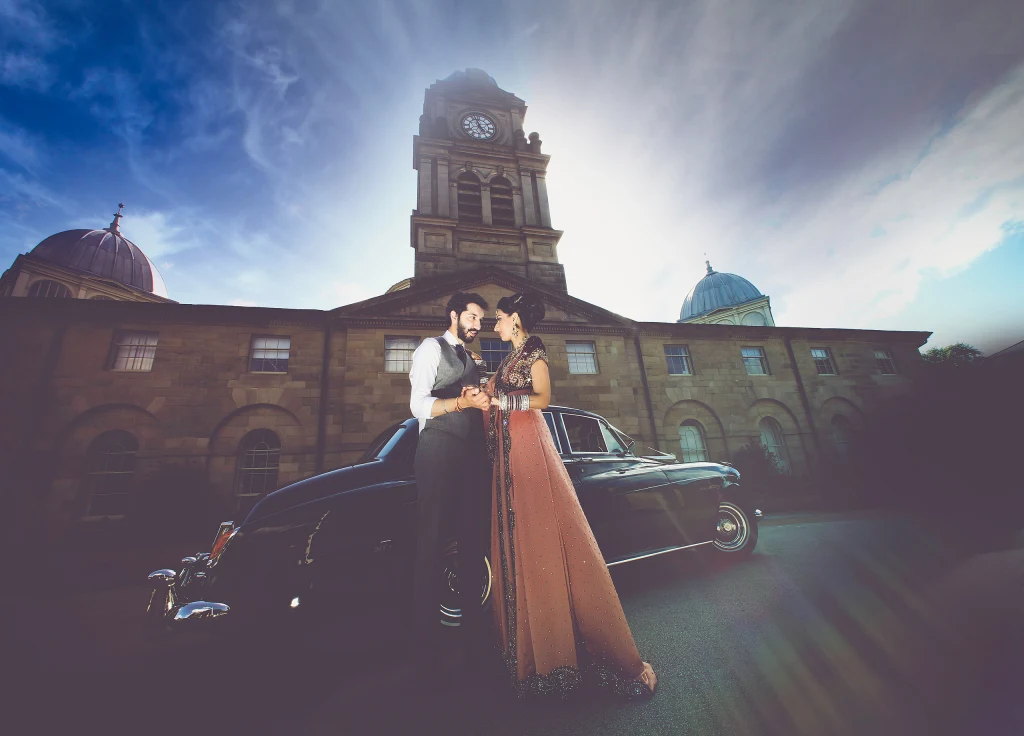
Used well, a drone gives a film its sense of place. In our experience the shots that earn their place are:
- The establishing shot: the venue and the landscape around it, which a camera on the ground can’t show.
- Scale: a long drive, a lake, a marquee in a field.
- Transitions: rising from one location and settling on the next, so the film moves through the day.
A drone doesn’t replace the film. The heart of a wedding film is what people say, and aerials are a few seconds of a three to five minute highlight film. Our guide to what’s in a wedding film explains how a highlight film is built.
What are the UK drone rules for weddings?
Most wedding aerials are flown in what the CAA calls the Open category: low-risk flying, including paid work, with no separate CAA authorisation as long as the flight stays inside its limits.
IDs. Anyone flying a drone of 100g or more needs a Flyer ID, which means passing the CAA’s theory test. Whoever is responsible for a drone of 250g or more, or 100g or more with a camera, needs an Operator ID, labelled on the drone.
Class marks. Since 1 January 2026, new drones sold in the UK carry a UK class mark, UK0 to UK6. Older unmarked drones follow rules based on their weight, and European C-marked drones can be flown as their UK equivalent until 31 December 2027.
Where it can fly, by type. The Open category has three sub-categories:
| Sub-category | Typical drone | Distance from uninvolved people |
|---|---|---|
| Over People (A1) | Under 250g, or UK0, UK1, C0 class | May fly closer than 50m and over them, but never over crowds |
| Near People (A2) | UK2 class, or under 2kg without a class mark; the pilot also needs an A2 Certificate of Competency | At least 30m for UK2 (5m in low-speed mode), 50m for unmarked drones; never over them |
| Far From People (A3) | UK2, UK3 and UK4 class, or under 25kg without a class mark | At least 50m from people, never over them, and at least 150m from residential, recreational, commercial and industrial areas |
Rules for every flight. Fly below 120m (400ft), keep the drone in direct sight, and never fly over people who are crowded together, whatever its size. The CAA defines a crowd as people who can’t move away quickly because of the people around them, and its examples include parties and religious gatherings. A wedding drinks reception can easily fit that description.
Insurance, night and privacy. Anyone paid to take pictures or video with a drone must have third-party liability insurance. A drone flown at night must show a green flashing light. And the Code reminds pilots that recordings may be covered by data protection law.
What that means on your day. We treat your guests as uninvolved people, so the drone doesn’t fly over the lawn, the aisle or the dance floor. Aerials happen away from the crowd: the venue before guests arrive, the grounds from a distance, the two of you walking alone. A big group shot from above often isn’t possible, because a gathered group of guests can count as a crowd. And wind or rain can ground a drone on the day.
Can you fly a drone at a London wedding?
Often not. Three things make central London difficult:
- Airports. The CAA says most airports, airfields and heliports have a flight restriction zone (FRZ): a circle of 2 or 2.5 nautical miles (roughly 3.7 to 4.6 km) around the longest runway, plus zones 1km wide running 5km out from each runway end. Heathrow, London City, Gatwick and Biggin Hill are all in or near our area. A drone can’t fly in an FRZ without that airport’s permission.
- Restricted airspace. The CAA lists royal palaces and government buildings among the places where flying is often restricted, and temporary restrictions are set up for events, sometimes at short notice.
- Space. Dense streets leave little room to keep the distances above, and larger drones must stay 150m from residential and commercial areas.
That is why some London venues simply aren’t suitable for aerials, and why we check every venue before we offer them. For portraits on the ground in town, see our guide to London city weddings, from register office to reception.
What about Kent and the countryside?
Country houses, barns and farms in Kent usually have the space London lacks: wide grounds and few neighbours. But check before you assume. Biggin Hill airport sits on the London and Kent border, Gatwick is not far to the south-west, and the CAA warns that smaller airfields may not appear on every map. A venue beside a village or a busy road may still be too close for a larger drone.
Do you need the venue’s permission to fly a drone?
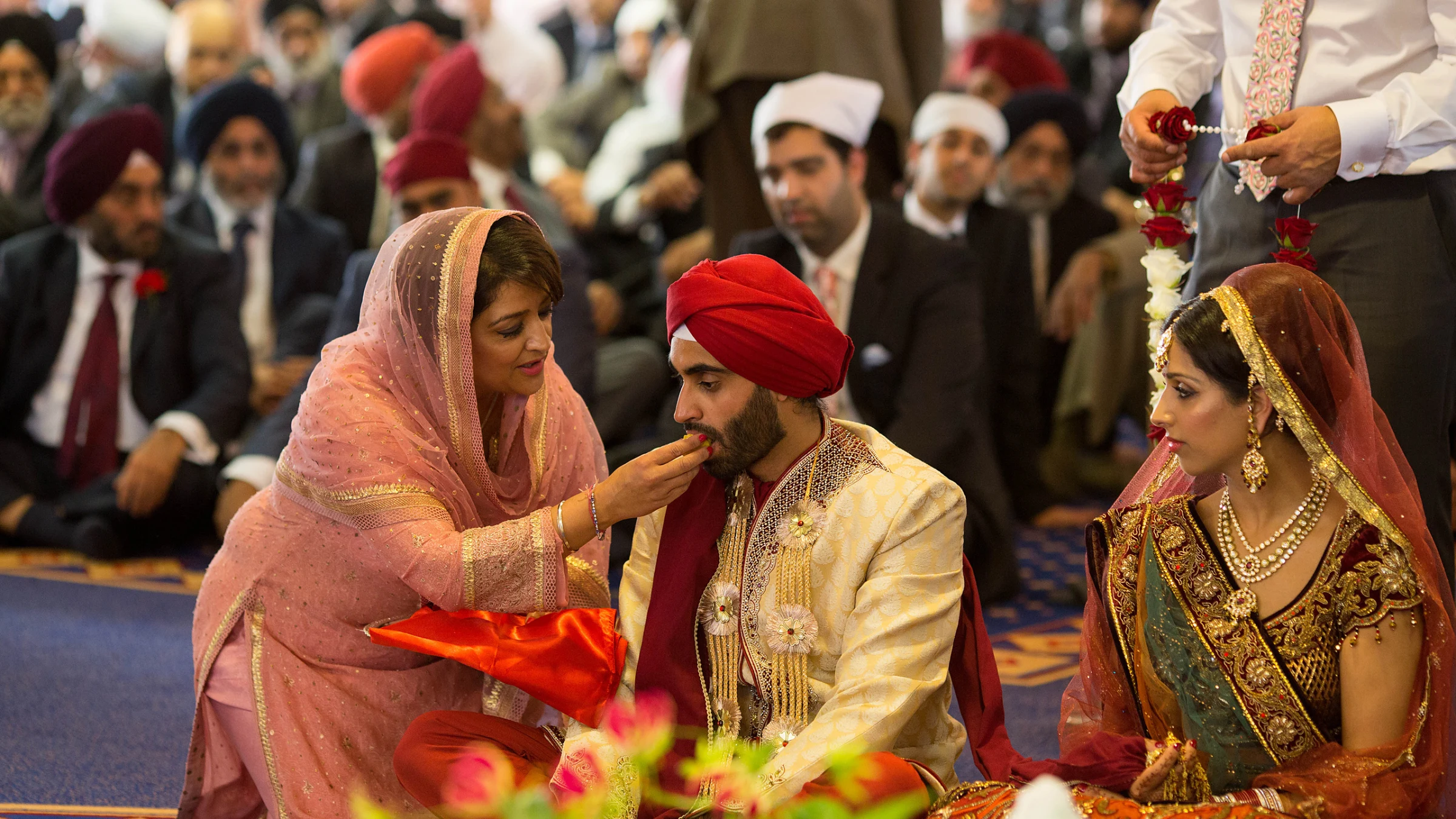
Yes. The CAA says you need the property owner’s permission to take off or land on their land, and many venues have a drone policy, so ask early. Places of worship have their own views: our guide to photographing and filming in a gurdwara includes drones in its list of questions. For a baraat on a public road, see our guide to planning the baraat.
The checks we make before a wedding drone flight
Drone work should be handled by a professional operator who flies within the CAA’s rules, not by a guest or a friend. Before we offer aerials, we:
- check the venue against the official airspace maps and any FRZ;
- ask the venue, and the officiant where relevant, for permission;
- plan take-off and landing away from guests and roads;
- check the operator’s IDs and insurance cover the flight;
- check temporary restrictions and the weather on the day;
- agree with you which moments we fly for, and never fly over the ceremony.
If any of these fail, we don’t fly, and we film the same moments from the ground.
When aren’t drone shots worth it?
Aerials are an optional extra. Skip them if:
- Your venue is in central London or close to an airport, where permission is unlikely or the shots would be limited.
- Your day is mostly indoors: a hotel ballroom, a banqueting hall or a winter wedding with early darkness.
- Your venue isn’t the story. A town hall and a restaurant are better filmed from the street.
- Your budget is tight. More coverage on the ground adds more to most films than a few seconds of sky.
For what aerials and other extras add to the cost, see how much a wedding videographer costs in the UK.
From behind the camera
The best drone shot of a wedding is usually taken when nobody notices. We fly early, while you are getting ready and the lawn is clear, so the venue looks its best. Later, a short flight while you walk across the grounds alone gives the film its scale without a single guest under the drone.
The flights we don’t make matter as much. If the wind picks up, a temporary restriction appears or the venue changes its mind, the drone stays in the case. We would rather tell you weeks ahead that aerials aren’t possible than promise a shot the rules or the weather won’t allow.
Frequently asked questions
Can you fly a drone at a wedding in the UK?
Often, yes, if the operator follows the CAA’s Drone and Model Aircraft Code and has the venue’s permission. The pilot needs the right IDs, the drone must stay below 120m and in sight, never fly over crowds, and stay out of airport flight restriction zones without permission. Check the current CAA rules.
Can you fly a drone at a London wedding?
Sometimes, but central London is hard. Much of it is near airports such as Heathrow and London City, or near royal palaces and government buildings where airspace is restricted, and dense streets leave little room to keep a legal distance from people. We check each venue and tell you honestly if aerials aren’t possible.
Do you need permission to fly a drone at your wedding venue?
Yes, in practice. The CAA says you need the property owner’s permission to take off or land on their land, and many venues have a drone policy. Ask your venue early, and for a gurdwara, church, mosque or synagogue, ask the committee or officiant too. Airspace permission is a separate request made by the operator.
Can a guest fly their own drone at our wedding?
The same CAA rules apply to a guest as to a professional, including IDs, distances from people and the ban on flying over crowds. A guest’s drone over a crowded lawn is a safety and privacy risk, so if you have a professional filmmaker, it’s reasonable to ask guests to leave their drones at home.
Keep reading
- What’s in a wedding film?: where aerials fit in a highlight film.
- How much does a wedding videographer cost in the UK?: what extras like aerials add.
- Photographing and filming in a gurdwara: questions for the committee, drones included.
Thinking about aerials? Tell us your venue and we’ll check what’s possible. See our wedding films, or book a call.