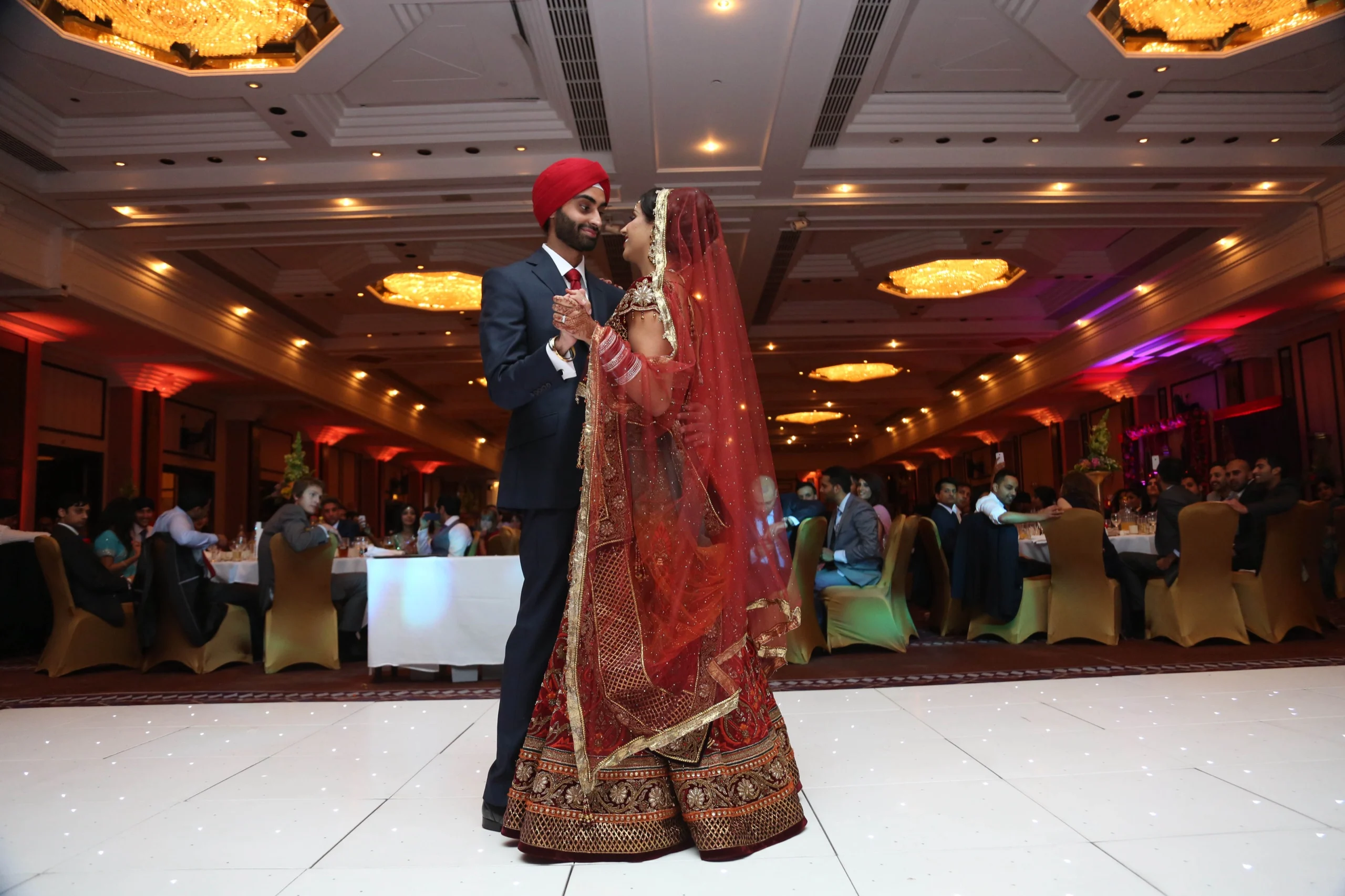
The mehndi and sangeet are usually the most relaxed, personal events of an Asian wedding, and the hardest to photograph well, because they happen at night, indoors, in rooms lit for atmosphere rather than for cameras. Get three things right and they become some of the best photographs and film of the whole week: the light, the running order and the sound.
This guide covers lighting at home, in a marquee or in a hall, the henna artist’s timing, performances and speeches, and whether you need film for the sangeet. It is one part of our day-by-day guide to planning a multi-day Asian wedding.
What happens at a mehndi and a sangeet?
Every family does it differently. For some, the mehndi is an afternoon of henna and songs for the bride’s side; for others it is a full party with a DJ. The sangeet is about music: rehearsed dances, family performances and often speeches. Punjabi families may add the jaggo, with its decorated pot of lights, and gidha and boliyan. Gujarati families may hold a garba or dandiya night. Muslim families often hold a mehndi for the women of the family. Many UK couples now combine the mehndi and sangeet into one evening, which works well on camera as long as we know which parts matter most.
Mehndi at home, in a marquee or in a hall: what changes for photos?
The venue decides almost everything about the light and the space.
| Setting | The light | What to plan | For film |
|---|---|---|---|
| At home | Warm bulbs and window light; low ceilings | Clear a corner by a window for the henna; tell neighbours about the dhol | Small rooms are loud, so we mic the speeches spot |
| Marquee or garden | After dark, only what the hire company installs | Warm white lighting on dimmers, not fairy lights alone | Ask for generators to sit well away |
| Hall or banqueting suite | DJ lighting, often coloured washes | A warm white wash on the stage for performances and speeches | An audio feed from the DJ desk, where the DJ agrees |
How do you light a mehndi night for photos?
Fairy lights create atmosphere, but they do not light faces. A room lit only by fairy lights and candles looks lovely to the eye and very dark to a camera, and coloured disco lights turn skin purple or green. A few requests make a real difference:
- Ask your decorator for warm white, dimmable lighting. Cool blue-white LEDs flatten skin tones and the reds and golds of your outfits.
- Keep one well-lit spot for the bride’s henna and a few portraits: a chair by a window, or under a warm lamp at night.
- Ask the DJ to save the colour effects for the dancing.
- Let your photographer add light. We bring small, quiet lights and use bounced flash at a party. If part of the evening is religious, such as a paath or a prayer, we work without flash.
Season matters too. In London the sun sets around 3.50pm in mid-December and around 9.20pm in late June, so at a winter mehndi we photograph the henna close-ups first, while the window light lasts. Our cinema cameras cope well in low light, but even they need some light on faces.
When should the photographer arrive? The mehndi artist’s timing
Full bridal henna takes hours, usually before the guests arrive. You do not need us for all of it. The best time to arrive is the last hour of the henna: the design is nearly finished, the bride’s hands and feet are at their most detailed, and family are starting to gather around her.
Tell your henna artist when the photographer arrives, and ask them to leave a little time once the design is done for close-ups before the paste starts to dry and crack. If the groom’s initials are hidden in the design, tell us, so we can photograph the search for them later.
A sample evening for a combined mehndi and sangeet at a hall:
| Time | What happens | Photo and film |
|---|---|---|
| 5.00pm | Last hour of the bride’s henna, in a side room | Henna details, the bride with close family |
| 6.30pm | Guests arrive, food opens | Arrivals, outfits, the room before it fills |
| 7.30pm | Dhol and entrance of the couple or the bride | Wide and close, film records the dhol |
| 8.00pm | Family performances, in running order | Front of stage, second camera wide |
| 9.00pm | Speeches from siblings and friends | Microphones on, warm light on the speaker |
| 9.30pm | Games, gidha or garba, open dancing | Candid coverage, then we finish around 10pm |
Adjust it to your family, and book coverage around the moments that matter, not the start time on the invitation.
Performances and choreography: how to make sure they are filmed well
- Send a running order a week before, with each performance, who is in it and roughly how long it lasts.
- Tell us where performers enter and which way the routine faces. Choreography aimed at the couple and the room, rather than sideways, films far better.
- Keep the front of the stage clear of guests with phones. A word from the MC helps, as our guide to unplugged moments explains.
- Leave the lights up. A routine in near darkness is hard to photograph and harder to film.
One note on music: performances are usually set to commercial songs. They belong in your full-length film for private viewing, but films with commercial tracks posted online often get copyright claims or muted audio, which is why highlight films use licensed music.
Dhol, games and the moments in between
The dhol is loud, joyful and the start of the party. For photographs, the best frames are the faces around the drummer, not the drum. For film, the dhol carries the energy of the edit, so we record it without letting it distort.
Then there are the moments families remember: the elders dancing, children asleep on chairs by 10pm, an aunt leading the songs. That is why we do not leave the moment the formal programme ends. If children perform, the ICO advises extra care with children’s images posted publicly, so we ask before sharing any child’s photograph.
Speeches at the sangeet
Sangeet speeches are often funnier and more personal than the reception ones. Ask speakers to use the microphone and tell us the order; we will speak to the DJ before the night. Our guide to getting speeches filmed and heard properly has the detail.
Do you need a videographer for the sangeet?
| What photography gives you | What film adds |
|---|---|
| Henna details, outfits and jewellery | The sound of the songs and the dhol |
| Expressions during performances | Whole routines, start to finish |
| Family groups and portraits | Speeches in the speakers’ own voices |
| A record for an album | Movement: the dancing, the jaggo, the garba circles |
If your family is performing, giving speeches or bringing in a dhol, film is the only way to keep it. If the mehndi is a quiet afternoon of henna and songs with close family, photography alone may be enough. Every event is priced on its own, so many couples book photography for the mehndi and both photo and film for the sangeet. Our article on what photo and film cost for a multi-day Asian wedding explains how to weigh it up, and if you are still deciding about film in general, read whether you need a wedding videographer.
From behind the camera
The mehndi is where we meet your family properly. By the wedding day, the aunties know our faces and the cousins have stopped noticing the camera, and that shows in every photograph. I always ask couples one question about the mehndi: who will be crying, and when? It is rarely the bride. Often it is a grandmother during a song, or a father watching his daughter’s hands being painted. We position ourselves for those people, not just the stage. In our experience, the sangeet film is often the one couples rewatch most, because it is the only event where the whole family performs for them.
Frequently asked questions
Do you need a photographer for the mehndi?
If the mehndi is the night your family lets go, yes. It is often the most relaxed event of the week, with the closest family, the bride’s henna and the first real party. Two to three hours of photography covers the henna details, the arrivals, the dancing and the elders, and every event can be booked on its own.
How long should a photographer stay at a mehndi or sangeet?
For a combined evening, four to five hours is usually enough: the last hour of the bride’s henna, guest arrivals, the performances, any speeches and the first stretch of dancing. If the performances run late, plan coverage around them rather than the start time on the invitation, and send your photographer the running order a week before.
Do I need a videographer for the sangeet?
If your family is rehearsing dances, giving speeches or booking a dhol, film is the only way to keep the sound and the movement. Photos show faces and colour; a film lets you hear your cousins singing and your father’s toast. If budget is tight, photography for the mehndi and film for the sangeet is a sensible split.
Can we hold the mehndi and sangeet on the same night?
Yes, and many UK families do. The henna is applied during the day or early evening, then the performances and dancing follow. For photo and film, one continuous booking covering both is usually simpler than two short ones, and it means the same team sees the whole evening unfold.
Keep reading
- Baraat and dhol: planning the groom’s arrival: the next morning’s procession, and how to keep it safe and on camera.
- Hindu wedding photography: the moments to plan for: from haldi to vidaai, the rituals your photographer must not miss.
- The Asian bride’s getting-ready checklist: what to have ready on the wedding morning, henna and all.
Planning your mehndi or sangeet?
Tell us each event, its date and the hours you need, and we will price them together. See how we cover Asian weddings and wedding films, or get a price for your dates.