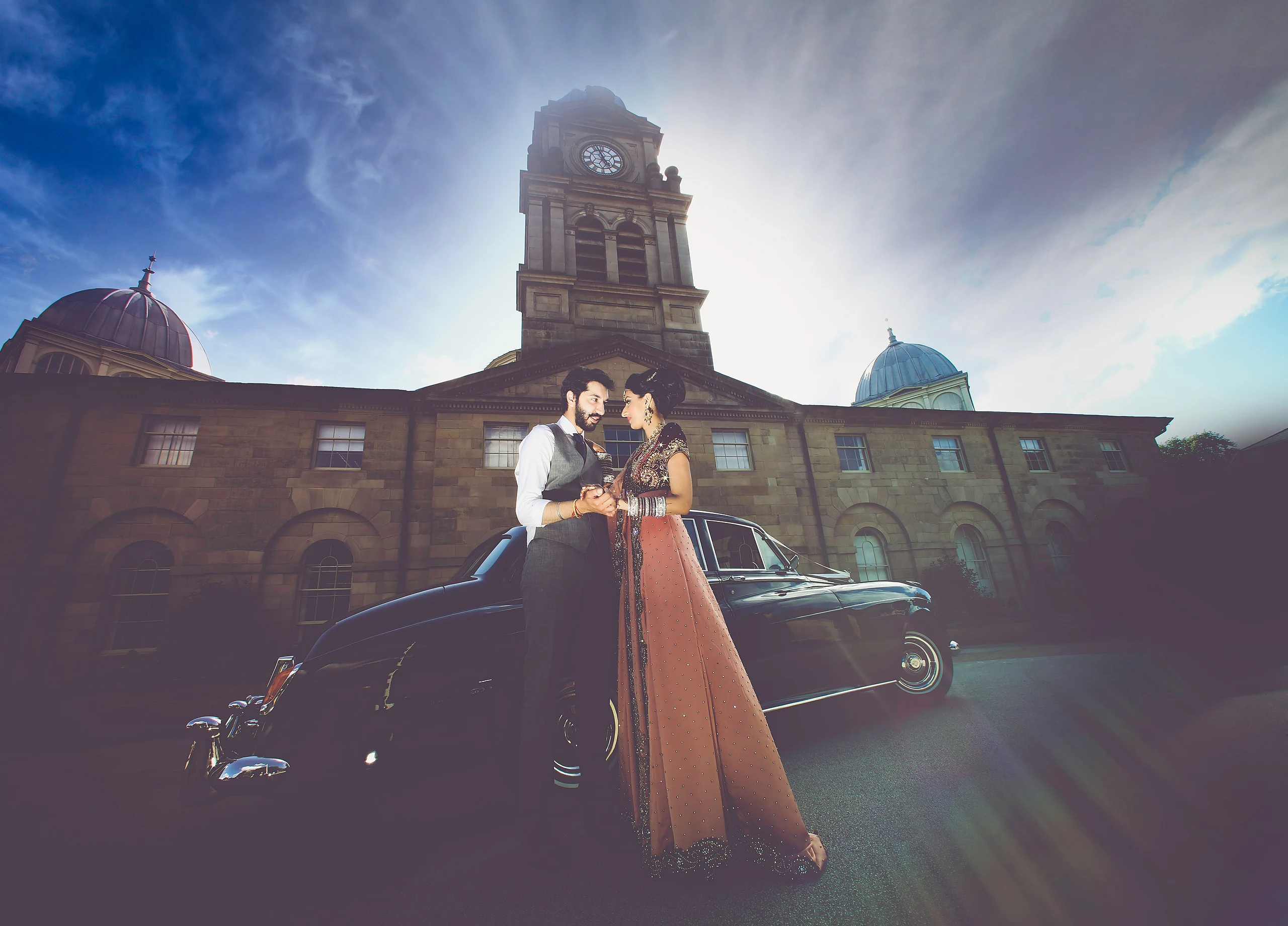
Choose the people whose complete weddings, not just their ten best pictures, look and sound the way you want to remember yours. Then check that you get on with them, that they know how your kind of ceremony runs, and that the contract, insurance and backup behind them are solid. Price matters, but it works best as the last filter, not the first.
This guide takes you through each check in the order we would use them, for a photographer and for a filmmaker, with the red flags to watch for and a shortlist process you can finish in about four weeks. We are a studio that does both, so we will be honest about where photo and film differ.
The short answer: Fix your date, venues and rough budget. Shortlist five to eight studios whose style you love, then ask each for two or three complete galleries and a full ceremony film from weddings like yours. Speak to your top three, compare like-for-like proposals, read the contract, and book the one you trust most.
Where do you start when choosing a wedding photographer?
Start with what you already know: your date (or at least a season), your venues and a rough budget for photo and film together. Without a date nobody can tell you whether they are free. Bridebook’s 2026 pricing guide suggests booking 18 to 24 months ahead for popular summer Saturdays and 6 to 9 months ahead for off-peak dates. Our guide to how far ahead to book your photographer and videographer explains what that means for weekdays, winter and multi-day weddings.
For the budget, Bridebook’s 2026 data puts the average UK spend at £1,484 on a photographer and £1,514 on a videographer, and the Bridebook UK Wedding Report 2026 says photography and video together take about 10% of the total wedding budget. Our breakdown of wedding photography and film costs in the UK explains what moves a price up or down, and you can see our own collections for your date.
Then build a long list from your venue, friends’ weddings, directories, Instagram and search. Treat every source as a way to find names, not as proof: a venue’s list reflects who knows the building, and Instagram shows only the best frame from each wedding.
Before you look, write a short brief of what your day involves:
- The ceremony: church, register office, approved venue, gurdwara, mandir, mosque, chuppah or a blessing.
- The events: one day, or several (mehndi, sangeet, haldi, civil ceremony, nikah, walima, reception).
- Film: whether you want it, and roughly what kind.
- Guest numbers: 30 guests and 300 guests need different coverage.
- Anything personal: a camera-shy partner, a grandparent who can’t stand for long, moments that should stay private.
Send the same brief to every studio you contact, and their proposals become much easier to compare.
How do you know which wedding photography style is right for you?
Style words are used loosely, so judge by the pictures rather than the labels. Most photographers blend several approaches. What matters is the balance, and whether it suits your day.
| Style | What it looks like | Ask yourself |
|---|---|---|
| Documentary (reportage) | The day as it happens, with little direction: real expressions and the in-between moments | Do we want the day as it felt, including the untidy bits? |
| Editorial | Composed, fashion-influenced portraits with strong use of light and setting | Do we want a handful of frames that feel like a magazine? |
| Traditional | Posed portraits and groups, everyone looking at the camera | Will our families expect a full formal set? |
| Fine art | Soft, light colour and carefully arranged details | Does this look hold up in a dark venue, not just a sunny garden? |
Look at the editing too. Check skin tones across a range of complexions, and how the edit handles rich colour: the reds and golds of Asian bridalwear, kente and aso oke. If skin looks orange or grey in their work, it will in yours.
Films have styles as well: a cinematic highlight film built on music, a documentary edit carried by the speeches, a full ceremony edit with clear audio. Our guide to highlight, feature and full ceremony edits explains what each contains, which helps when you compare prices.
Why should you ask to see full wedding galleries, not just highlights?
A portfolio is a photographer’s best few frames from dozens of weddings. A full gallery is what you will actually receive. Ask every studio on your shortlist for two or three complete galleries from weddings like yours: the same season, a similar venue and size, ideally the same kind of ceremony.
What to look for:
- Consistency. Does the quality hold from the morning to the last dance?
- Difficult light. A dark church, a register office under strip lights, a December afternoon, a reception lit by uplighters. This is where experience shows.
- The ceremony. Are the key moments there, from the right side, with both faces visible: the rings, the laavan, the pheras, the signing, the first kiss?
- Family groups. Everyone sharp, eyes open, nobody cut off, large groups arranged so every face can be seen.
- Guests. Are people shown kindly? Would your aunt be happy with how she looks?
- Variety without repetition. A good gallery tells a story. A padded one shows twelve near-identical frames.
Size isn’t quality. Bridebook says lightly edited full-day galleries usually run to 400 to 600 images, and our guide to how many photos to expect from your wedding explains why the number varies.
For film, ask to watch a full ceremony edit and an uncut set of speeches, not only the highlight film. Put headphones on. Can you hear the vows clearly? Do the speeches sound like they were spoken into a microphone, or across a noisy room?
Do you need to meet your wedding photographer before booking?
Yes, even if it is a video call. You will spend more of your wedding day with your photographer and filmmaker than with almost anyone else, and the rapport shows in the pictures. A simple test: would you get on with this person if you met socially?
On the call, notice:
- Who asks the questions. A good photographer wants to know about you, your families and how the day will run before talking about packages.
- Whether they listen. Do they pick up on the grandparent you mentioned, or the ceremony time that clashes with sunset?
- Straight answers about what is included, what costs extra and when you will receive everything.
- Who will be there on the day. In a larger company, the person on the call may not be the person at your wedding. Ask to speak to whoever will actually attend.
Our own calls take around half an hour, with no pressure to book: you can book a call with us to see how we work. Wherever you go, take our 30 questions to ask your photographer and videographer into every call.
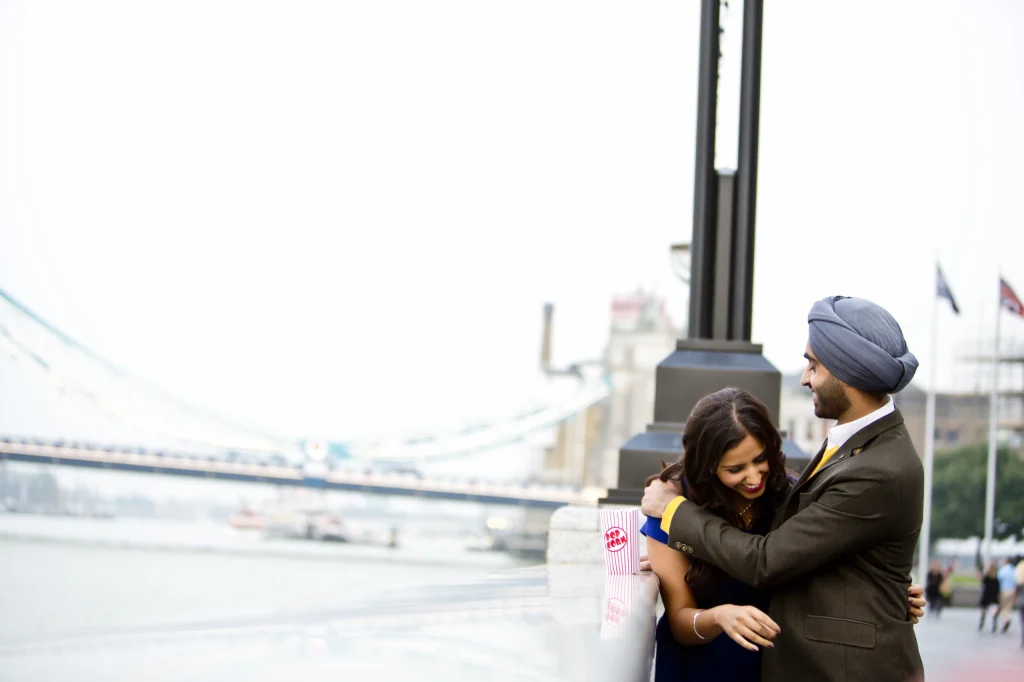
If one of you dreads the camera, say so early. An engagement shoot in London is a good way to get used to the camera, and the person behind it, before the day, and our guide for camera-shy couples has more ideas.
Have they photographed and filmed weddings like yours?
Experience matters most where ceremonies have rules and moments happen once. A photographer who has never stood beside a mandap or inside a gurdwara will spend your ceremony working out where to be. Ask specifically, and ask to see the result.
| Your ceremony | What experience looks like |
|---|---|
| Anand karaj in a gurdwara | Head covered and shoes off without being asked, never standing above or with their back to the Guru Granth Sahib, positions agreed with the granthi or committee, ready for the palla moment and all four laavan |
| Hindu ceremony at a mandap | Knows the order of the kanyadaan, pheras, saptapadi and sindoor, and where to stand for each |
| Nikah | Follows the imam’s and the mosque’s guidance, plans for separate spaces where families want them, and can discuss a female photographer or filmmaker for women-only events |
| Jewish wedding | Knows the ketubah signing, bedeken, chuppah and yichud, and checks with the rabbi, as photography may be restricted in Orthodox synagogues |
| Church wedding | Speaks to the vicar first: under Church of England guidance the vicar has the final say on photography and filming during the service |
| Register office | Checks the local rules, which vary by council, especially around the ceremony and the signing |
| African wedding | Plans for a traditional engagement and a white wedding, often on different days, and an MC-led running order |
A good answer is specific. They describe your running order back to you, say where they expect to stand, and offer to speak to your officiant before the day. Equally, a good studio never assumes your traditions from your names. Every family does things its own way, and the right photographer asks.
Scale matters too. A 300-guest wedding with both families arriving at once needs a different plan from an 80-guest country house wedding, especially for the family photo list. For celebrations across several days, our multi-day Asian wedding timeline shows how much changes from one event to the next, and our Asian weddings page explains how we cover them. For the rules in each kind of venue, see our guide to photography during the ceremony in the UK, or our older article on Sikh wedding ceremony traditions.
Do you need a photographer and a videographer?
You don’t have to have both. According to Bridebook, over 90% of couples hire a photographer and about one in three book a videographer. They keep different things. Photographs give you the frames you print and put in an album. A film gives you voices, movement and every word of the vows and speeches.
If you are unsure, our honest answer on whether you need a wedding videographer goes through it, including when we think you might not. There is also a middle ground: a simple wedding film with one filmmaker for up to four hours, covering the ceremony, the speeches and a short highlight film.
Should you book your photographer and videographer from the same studio?
It changes how the day runs. With one team there is one plan and one timeline. Ceremony positions are agreed in advance, so the filmmaker isn’t in the back of your photographs and the photographer isn’t in the middle of your film. Flash, lighting and the portrait session are planned once, the colour of photos and film tends to match, and you have one point of contact. Many studios, ours included, also price the two together for less than separate bookings.
Two separate suppliers can work well too, as long as they talk before the day and agree positions for the ceremony and speeches. Our guide to booking your photographer and filmmaker together covers the trade-offs in detail, and you can see how we approach each on our wedding photography and wedding films pages.
What should a wedding photography contract include?
Never pay a booking fee without a written contract. A good one is clear enough that a friend could read it and know exactly what you have booked.
| Clause | What to look for |
|---|---|
| Date, venues and hours | Start and finish times for each event, and the overtime rate |
| Who will attend | The named photographer and filmmaker, plus any second shooter or second camera |
| What you receive | Gallery, films and their lengths, album specification and delivery times |
| Price and VAT | Whether VAT is included. Under GOV.UK rules a business must register once taxable turnover passes £90,000, and then adds 20%; smaller studios may not charge it |
| Booking fee and balance | How much holds the date, whether any of it is refundable, and when the balance is due |
| Postponement and cancellation | What happens if you move your date, and if they cancel |
| Illness or emergency | How a replacement is chosen, and from whom |
| Use of your images | Whether they may use your photos and film in their portfolio or on social media |
| Travel and meals | What is included, and what you are expected to provide |
Two legal points are worth knowing. If you book online, by email or by phone, the Consumer Contracts Regulations 2013 generally give consumers 14 days to cancel a services contract from the day it is made. There is an exemption for leisure services booked for a specific date, and whether wedding photography counts hasn’t been tested, so ask how the studio handles those first 14 days. And while the photographer or filmmaker usually owns the copyright, section 85 of the Copyright, Designs and Patents Act 1988 lets a couple who commission photos or film for private and domestic purposes stop copies being shown to the public. That is why a good contract asks your permission for portfolio and social media use rather than assuming it.
What happens if your wedding photographer is ill?
The answer tells you a lot about how a studio is run. Ask about four things:
- A named backup. A small network of trusted photographers and filmmakers, not a plan to “find someone”.
- Equipment. At least two camera bodies, cameras that record to two memory cards at once, and for film, a second audio recorder for the vows and speeches.
- Your files. Copied to at least two places the same night, one of them away from the studio. Ask how long they keep a backup after delivery.
- Insurance. Public liability and professional indemnity. Some venues ask suppliers for a certificate.
Our own answer: we work with a small team of trusted photographers and filmmakers, so your day is always covered, and we carry full professional indemnity and public liability insurance.
What will you actually receive, and when?
Compare what each studio delivers, not only the hours. Where a figure is given, it comes from Bridebook’s 2026 pricing guides.
| Deliverable | Typical UK picture | What to ask |
|---|---|---|
| Sneak peek | Many studios send a few images within days | When, and how many? |
| Full photo gallery | Usually 4 to 12 weeks | Is the date in the contract? |
| Gallery size | 400 to 600 lightly edited images for a full day | Is every image edited? |
| RAW files | Rarely supplied | If you want them, is it in writing? |
| Highlight film | 3 to 10 minutes, with 5 to 8 typical | Built on music, on your words, or both? |
| Feature or full edit | Varies widely; Bridebook gives 30 to 90 minutes | Does it include the ceremony, speeches and evening? |
| Album | Optional with most studios | Who designs it, and how many spreads? |
For reference, we send a sneak peek within days, a full edited gallery usually within four weeks, and films within two to three months, depending on the season. Our guide to wedding photo and film delivery times explains why film takes longer, and our guide to lay-flat, fine art and parent albums covers what to ask about albums.
Red flags when choosing a wedding photographer or videographer
These signs suggest you should keep looking:
- No full galleries or full films, only highlights.
- No written contract, or one that doesn’t say who will attend or when you will receive everything.
- Vague answers on backup and insurance. “It’s never happened” is not a plan.
- Pressure to decide today because someone else wants your date.
- A portfolio that doesn’t match the claim: plenty of talk about Asian or Jewish weddings, nothing to show from one.
- Films with poor sound. If you can’t hear the vows in their examples, you won’t hear yours.
- No answer on music licensing. Films with commercial tracks are often muted or taken down online, so ask what you will be able to share.
- A price far below others for the same hours. Ask what is missing: editing time, a second shooter, insurance. Bridebook estimates that a photographer charging £1,500 or more may spend 40 to 60 hours on one wedding, once meetings, editing and delivery are counted.
- Reluctance to speak to your officiant or venue. At a place of worship, this matters more than almost anything.
A shortlist process that works
This takes about four weeks, whether you are booking photo, film or both.
| Step | What to do | When |
|---|---|---|
| 1 | Fix your date, venues, rough budget and your short brief | Week 1 |
| 2 | Build a long list of 8 to 10 names and cut it to 5 to 8 on style alone | Weeks 1 to 2 |
| 3 | Check availability and ask for two or three full galleries and a full ceremony film | Week 2 |
| 4 | Book calls with your top three, ideally with both of you on the call | Week 3 |
| 5 | Ask for written proposals and compare like for like: hours, people, films, album, VAT | Weeks 3 to 4 |
| 6 | Read the contract carefully and ask about anything unclear | Week 4 |
| 7 | Pay the booking fee and get written confirmation of your date | Week 4 |
If two studios are close, choose the one you felt most comfortable with on the call.
From behind the camera
When couples ask me what to look for in a full gallery, I suggest they skip the portraits and go straight to the ceremony and the speeches. Portraits are planned, in good light, with time to get them right. Ceremonies aren’t. The light is whatever the building gives you, there is no flash during the service, and every moment happens once. If a photographer’s ceremony pictures from a dim church or a gurdwara darbar hall are sharp, warm and well framed, the rest will be fine.
I do the same with film, but with headphones on. Listen to a best man’s speech in a full edit. If you can hear every word over the clatter of the room, that filmmaker plans sound properly: a microphone where the speaker will stand or a feed from the DJ’s desk, a backup recorder running, levels checked before the first speech. You can’t fix poor sound in the edit, and in a wedding film the words are what you will come back to.
Your questions, answered
When should I book my wedding photographer?
As soon as your date and venue are fixed. Bridebook’s guidance is 18 to 24 months ahead for popular summer Saturdays and 6 to 9 months for off-peak dates. Weekday and winter dates are often available at shorter notice, so if your wedding is close, ask anyway: the worst answer is a polite no.
Do I need a second shooter for my wedding?
Not always. Bridebook suggests a second photographer for weddings of 80 guests or more, and it helps when you are getting ready in two places, or at big Asian or African weddings where both families arrive at once. For a register office wedding or a small celebration, one experienced photographer is usually enough.
Do wedding photographers give you all the photos?
You receive every image worth keeping, each one edited, but not the unedited RAW files. Most photographers remove duplicates, blinks and test frames, then colour-correct the rest so the gallery looks consistent. If you want RAW files, ask before you book: few photographers supply them, and the contract should say either way.
Is it normal to be disappointed with wedding photos?
It happens, and it usually comes from a gap between what a couple expected and what the photographer delivers. The best protection is to look at two or three complete galleries before you book, not just a portfolio, and to tell your photographer which moments and people matter most. If you are disappointed afterwards, say so calmly and early.
Keep reading
- 30 questions to ask your wedding photographer and videographer: the questions to take into your calls, with what a good answer sounds like.
- Do you need a wedding videographer?: an even-handed look at film, from a studio that sells both.
- One studio or two?: what changes on the day when your photographer and filmmaker work as one team.
If we are on your shortlist, book a relaxed half-hour call and ask us anything in this guide. We will tell you honestly whether we are the right fit for your day.