A UK Sikh wedding day usually starts at dawn and ends after midnight. The chooda and the groom’s preparations happen early at home, the baraat reaches the gurdwara around 08:30 to 09:00, the milni and tea follow, the Anand Karaj runs from about 10:00 or 10:30 to around midday, then come langar, the doli and, that evening, the reception.
Below is a clock-time plan for a typical gurdwara morning and evening, with where photographs and film fit. If your wedding runs over several days, our multi-day Asian wedding timeline shows how the Sikh wedding day sits within the whole week.
How long is a Sikh wedding?
The Anand Karaj itself usually takes about an hour. The wedding as a whole is much longer. Most of the Sikh families we work with hold events across three or four days:
| When | Event | What happens |
|---|---|---|
| A few days before | Maiyan (vatna) | Family rub a paste of turmeric, flour and oil onto the bride and groom, each at their own home |
| Two or three days before | Mehndi | Henna for the bride, music and food |
| The night before | Jaggo | A decorated pot of lights, singing and dancing through the party |
| Wedding morning, or the evening before | Chooda and kalire | The bride’s maternal uncle gives the chooda; sisters and friends tie the kalire |
| Wedding day | Baraat, milni, Anand Karaj, langar, doli | The ceremony at the gurdwara and the farewell |
| Wedding evening, or another day | Reception | Entrances, speeches, first dance, bhangra |
Families differ: some combine the mehndi and jaggo, some hold the chooda the night before, some hold the reception a week later. Our older post on Sikh wedding ceremony traditions explains the meaning of each ritual, from the roka to the doli.
What time does an Anand Karaj start?
In our experience, most UK gurdwaras hold the Anand Karaj in the morning, and many like it finished by around midday. Each gurdwara sets its own slots, and some have more than one wedding on a Saturday. Ask the committee for your time before you book anything else: it fixes the whole day.
Sikh Council UK’s guidance on the Anand Karaj says the ceremony should take place in a gurdwara, not a hotel or other venue, so the morning at the gurdwara and the evening at a reception venue is the usual shape. Many gurdwaras are not registered for marriages, so many couples add a civil ceremony on another day: our guide to getting married legally in England and Wales explains the options.
A typical UK Sikh wedding day, by the clock
This is a sample for a gurdwara that starts the Anand Karaj at 10:30, with the reception the same evening. Move every time to suit your gurdwara.
| Time | Bride | Groom | Photo and film |
|---|---|---|---|
| 05:30 | Hair and make-up begins at home | Second photographer at the bride’s home for details and make-up | |
| 06:30 | Chooda ceremony with the maternal family; kalire tied | Getting ready, turban tied | Lead pair with the bride; second pair with the groom |
| 07:30 | Dressing; final portraits at home | Family blessings, leaving with the baraat | Groom’s crew travels with the baraat |
| 08:30 | Bride stays at home or waits in a side room | Baraat arrives at the gurdwara, ardas outside | Both crews at the gurdwara entrance |
| 08:45 | Milni: the two families meet and exchange garlands | Close coverage of each pair, wide shots of both families | |
| 09:15 | Tea and breakfast in the langar hall | Candid coverage, a break for the crew to set positions | |
| 10:15 | Bride arrives at the gurdwara | Groom seated before the Guru Granth Sahib | Positions agreed with the granthi; audio checked with the ragis |
| 10:30 | Anand Karaj: ardas, shabad, the palla ceremony | No flash, quiet movement | |
| 10:45 | The four laavan | Every round filmed; photographer moves around the edge | |
| 11:15 | Anand Sahib, ardas, hukamnama, karah parshad | ||
| 11:30 | Family blessings and shagun for the couple | Close family photographs, in the hall or outside as the gurdwara allows | |
| 12:00 | Langar | Candid coverage; 20 minutes of couple portraits outside | |
| 13:30 | Doli from the gurdwara or the bride’s home | Both crews together | |
| 15:00 | Rest and outfit change | Crew travels to the reception venue and sets up | |
| 18:30 | Guests arrive at the reception | Room details, guests arriving | |
| 19:30 | Couple’s entrance | Two filmmakers, two photographers | |
| 20:00 | Dinner, speeches, cake, first dance | Clean audio of every speech | |
| 21:30 | Bhangra and dancing | Dance floor, family, late portraits | |
| 23:30 | Finish |
Many couples book the morning from the chooda to the doli, then the reception from the entrance to the first hour of dancing. Our Sikh wedding films page shows what a full day looks like on screen.
The wedding morning: maiyan, chooda and kalire
The maiyan, held at home a few days before, photographs best in daylight by a big window or in the garden. Allow about two hours.
The chooda is one of the most tender moments of the morning. The bride’s maternal uncle presents the bangles, the family gather close, and the kalire follow, tied by sisters and friends, with the bride shaking them over her unmarried friends’ heads. Because UK gurdwaras start early, the chooda often happens at 06:00 or the night before. A living room with the curtains open is better for it than a dim bedroom. Our getting-ready checklist for Asian brides helps you plan hair, make-up and jewellery around it.
Baraat and milni at the gurdwara
In the UK the baraat usually arrives by car, and many families walk the last stretch with a dhol. There is an ardas outside, then the milni: relatives from each family meet in pairs, usually starting with the fathers, then the maternal uncles and other elders, embracing and exchanging garlands. Give your photographer the list of milni pairs in order, with names. Planning the baraat and dhol covers the arrival in detail.
The Anand Karaj: palla and laavan
The groom sits before the Guru Granth Sahib first, and the bride joins him. After the ardas and a shabad, the bride’s father places one end of the palla, the scarf the groom wears, in the bride’s hand. It is the moment most families tell us they want photographed, so we agree in advance where the photographer will be to see both faces.
The four laavan are the heart of the ceremony. For each one, the granthi reads the lav, the ragis sing it, and the couple walk clockwise around the Guru Granth Sahib, the groom leading and the bride holding the palla. Brothers and cousins often stand at the corners to guide and support the bride. The ceremony closes with the Anand Sahib, a final ardas, the hukamnama and karah parshad.
The darbar hall has its own rules: head coverings, no shoes, no flash, and positions agreed with the granthi. We cover these for couples and families in what to know about photographing in a gurdwara.
Langar, family photographs and the doli
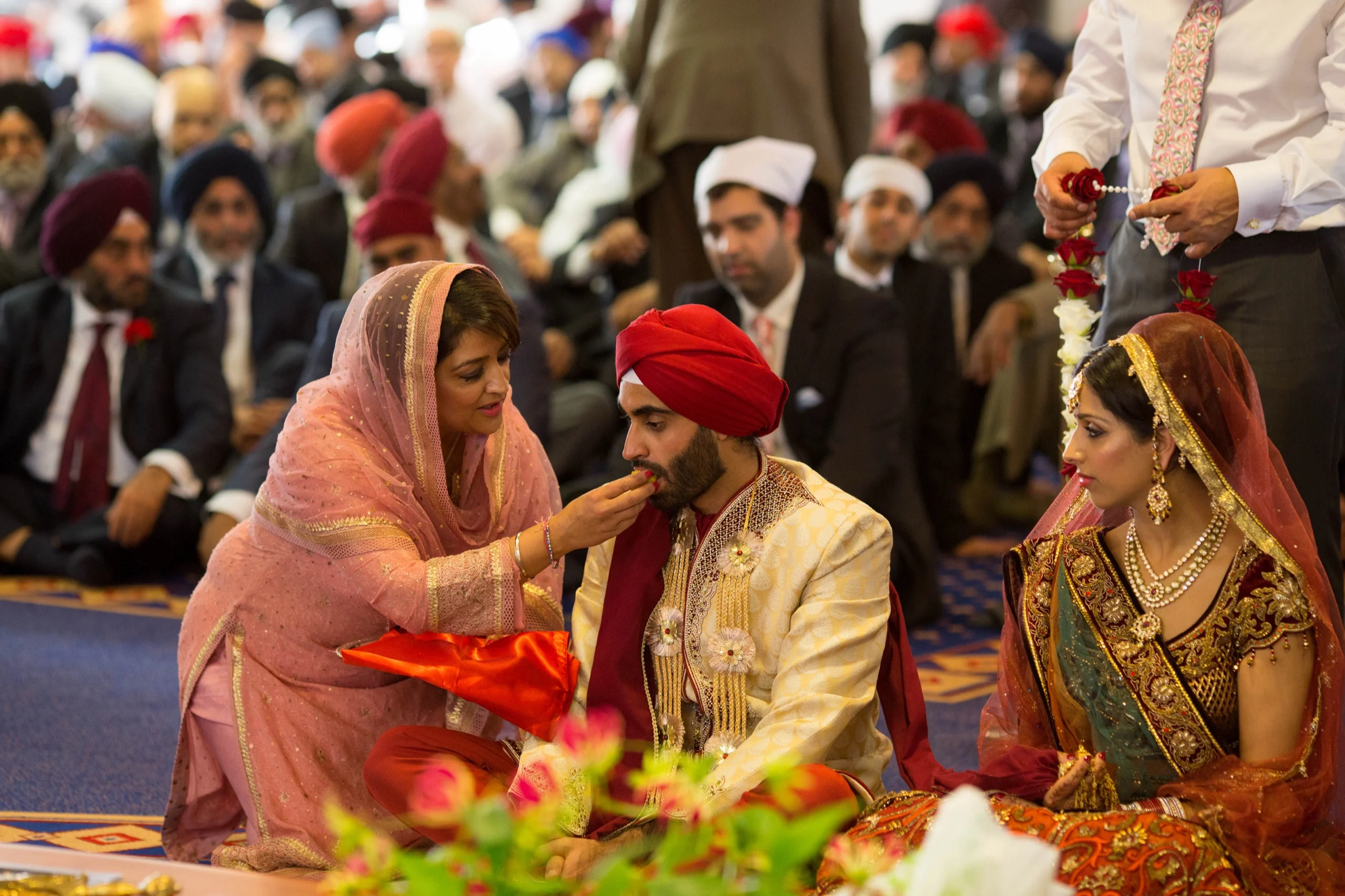
After the ceremony, close family give their blessings and shagun, then everyone eats langar. This is the best window for family photographs and 20 minutes of couple portraits outside. For a large family, see how to plan your family photo list.
The doli, the bride’s farewell to her family, is one of the most emotional moments of the whole wedding. It may happen at the gurdwara or at the bride’s home, and it needs both crews: one with the bride, one on the family.
The evening reception
Allow 60 to 90 minutes for the bride’s change and make-up refresh, plus travel. The crew needs 30 to 45 minutes at the reception before your entrance to set lighting and connect microphones with the DJ. In winter, London sunsets come around 15:50 to 16:20, so outdoor couple portraits belong at the gurdwara around midday.
From behind the camera
The Anand Karaj moves at its own pace, so most of our planning happens before the day. I always ask for three things: the gurdwara’s start time in writing, the list of milni pairs, and the name of the person who will place the palla. With those, we know where to stand at every moment that can’t be repeated.
For film, the laavan are about sound as much as picture. There are no spoken vows from the couple, so the audio comes from the granthi and the ragis. We ask the gurdwara before the day whether we may take a feed from their sound system or place a small recorder near the ragis, so every lav is clear in your film.
Frequently asked questions
How long is a Sikh wedding?
The Anand Karaj itself usually takes about an hour in the darbar hall. The full wedding day is much longer: from the chooda at home to the end of the reception, many UK Sikh wedding days run 16 to 18 hours, and the maiyan, mehndi and jaggo usually take place on the days before.
What time does an Anand Karaj start?
Most UK gurdwaras hold the Anand Karaj in the morning. A common pattern is the baraat arriving around 08:30 to 09:00, the milni and tea, and the ceremony starting between 10:00 and 11:00. Every gurdwara sets its own slots, so ask your committee for yours before you plan anything else.
Do you need a civil ceremony for a Sikh wedding in the UK?
It depends on your gurdwara. In England and Wales, an Anand Karaj is legally binding only if the gurdwara is registered for marriages and an authorised person or registrar is present. Some gurdwaras are registered and many are not, so many couples hold a civil ceremony as well. Ask your gurdwara and your local register office.
Can you have an Anand Karaj at a hotel?
Sikh Council UK’s guidance says the Anand Karaj should take place in a gurdwara, not in a hotel or other venue, and most UK gurdwaras follow it. Couples who want a venue for the day usually hold the Anand Karaj at the gurdwara in the morning and the reception at a hotel or banqueting hall.
Keep reading
- Photographing and filming in a gurdwara: head coverings, positions, phones and the palla, for couples and families.
- Multi-day Asian wedding timeline: how the maiyan, mehndi, jaggo and reception fit around the wedding day.
- Baraat and dhol: planning the groom’s arrival: route, timings and safety so the arrival is filmed well.
If you have your gurdwara’s start time, send it to us with your reception details and we will help you build the day: check your date.